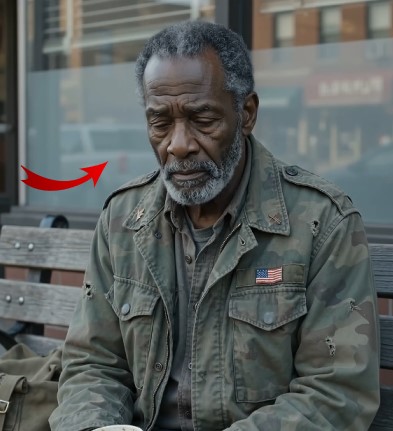
At 78 years old, Robert still remembers the feeling of sitting down in a small American diner after returning home from military service. Decades have passed, the world around him has changed, and the uniform he once wore has been replaced by an old, faded military jacket. Yet one painful memory has never completely left him.
Today, Robert is thin and physically frail. His hands shake slightly as they wrap around a warm cup of coffee. Sitting quietly in a diner booth, he looks around at the counter, the customers, and the servers carrying plates between tables.
To everyone else, it is simply an ordinary diner.
To Robert, it brings back a story he has carried for most of his life.
“When I came home from war, I walked into a diner just like this one,” Robert recalls. He had been away serving his country and was exhausted from the journey home. More than anything, he remembers being hungry.
He found a seat and waited.
Minutes passed. Then more time passed. Other customers were served while Robert remained at his table. Eventually, according to his recollection, a waitress approached him.
Robert expected her to take his order.
Instead, he says he was told that the restaurant would not serve him because he was Black.
The memory is especially difficult for Robert because he was still wearing his military uniform.
“I had served my country,” he remembers. “I had made it home alive. And all I wanted was something warm to eat.”
Confused and embarrassed, the young veteran asked whether he had done something wrong. He says he received little explanation beyond the discriminatory refusal.
Rather than create a confrontation, Robert quietly stood up and walked outside.
He was still hungry.
But what happened next became just as memorable as the rejection itself.
Robert sat outside wondering how a man could return from military service yet still be judged by the color of his skin. A few moments later, an older Black gentleman came out of the diner and approached him.
The stranger was carrying a sandwich.
He offered it to Robert.
Robert initially refused, explaining that he did not want to take another man’s food. But the stranger insisted. More importantly, he offered Robert something beyond a meal: compassion at a moment when the young veteran desperately needed it.
The older man reminded him that accepting kindness did not make him weak and that another person’s prejudice could never determine his value.
Those words stayed with Robert.
The sandwich itself was simple and inexpensive. Yet decades later, Robert says he can still remember the dignity that stranger restored with one small act of generosity.
Robert eventually built a life beyond that painful afternoon. He worked, experienced happier years, raised a family, and watched society change in ways his younger self could hardly have imagined.
Still, whenever he enters an old-fashioned diner, part of him remembers that hungry young veteran waiting at a table.
Now, at 78, Robert says his story is not about asking anyone to feel sorry for him. Instead, he hopes people will understand why everyday respect matters.
We rarely know what another person has survived simply by looking at them. Clothes cannot reveal someone’s sacrifices. Age cannot tell their complete history. Race should never determine how much dignity a person receives.
Sometimes the person sitting quietly in the corner carries an extraordinary story that nobody in the room knows.
Robert takes another small sip of coffee and looks around the diner.
His message after all these years is remarkably simple: before deciding who someone is, give them the dignity of being seen, heard, and treated like a human being.
Because sometimes a little kindness is remembered for a lifetime.