“`html
PART 2: The General Saluted Me—Then My Father Had to Face the Truth
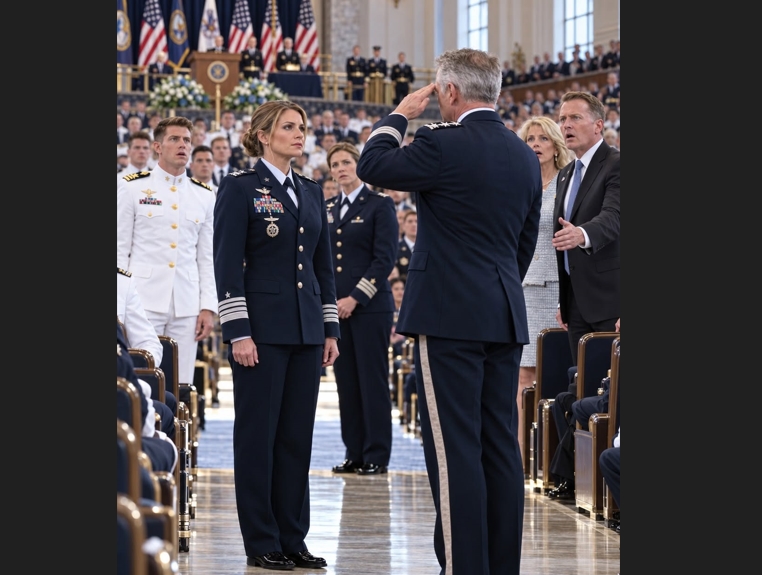
His hand stopped at his brow.
“Vice Admiral Barker,” General Miller said. “It’s an honor to see you again, ma’am.”
Behind him, a chair scraped across the floor. Then another.
Within seconds, the entire room was standing.
My father remained beside the aisle, his hand still extended toward someone who had already passed him.
“Thank you, General,” I said quietly. “But please. Today belongs to the graduates.”
Miller glanced toward James, then back at me.
“Your brother?”
I nodded.
“He’s worked hard to be here.”
Across the room, James lowered his eyes.
The general escorted me to an empty seat near the front. As I passed my father, he caught my sleeve.
“Maria,” he whispered. “What is happening?”
I gently freed my arm.
“James is graduating, Dad. Let’s watch him.”
And we did.
I applauded when my brother’s name was called. I watched him stand a little straighter as he accepted the recognition he had earned. Whatever had happened between us, I would not take that moment away from him.
After the ceremony, I slipped outside toward the courtyard.
“Maria. Wait.”
James hurried after me, carrying his program in both hands. The paper had begun to crease between his fingers.
“You’re really a vice admiral?”
“Yes.”
“How could I not know?”
I looked at him.
“Do you remember the envelope I sent when I took command? You called and asked whether the photograph inside was from an office party.”
He stared at the ground.
“Dad said—”
“I know what Dad said. I also know you had my number.”
For a moment, neither of us spoke.
“I laughed at you,” he said finally.
“Yes.”
“At dinner. At the barbecue. I liked being the one he was proud of.” His voice faltered. “I’m sorry.”
I let him finish without making the apology easier for him.
“I’m proud of what you accomplished today, James. But I need you to understand something. If I had left the Navy, none of those jokes would have been kinder.”
He nodded slowly.
“I understand.”
“Then show me. That will matter more than what you say right now.”
My parents appeared at the courtyard entrance.
Dad approached first. His face was flushed, and his eyes kept moving toward the officers passing behind me.
“Twenty years,” he said. “And you never thought to explain?”
Mom stopped beside him.
“Robert. She did.”
He turned toward her.
“The letters,” she continued. “The invitations. She asked us to come to her change of command.”
“I thought those were administrative things.”
“You never asked,” I said.
He opened his mouth, then closed it.
“I was busy with James. There was always something—”
“I wasn’t asking you to choose between us. I was asking you to be interested in both of us.”
Mom wiped beneath one eye.
“And I should have spoken up,” she said. “Instead, I kept asking you to ignore him so we could have a pleasant visit.”
I had waited years to hear someone acknowledge that.
Dad looked at me again.
“Well, I’m proud of you now.”
The words hurt more than I expected.
“I wanted you to be proud of me,” I admitted. “But I needed you to treat me kindly long before today.”
His shoulders dropped.
“What do I do?”
“Stop calling me a failure. Stop making me the joke. And when I tell you something about my life, listen.”
There was no embrace in the courtyard. We took a photograph for James, and afterward I went back to my hotel alone.
Three days later, Dad called.
“I found your letters,” he said.
I sat down.
He asked about a command I had held eight years earlier. This time, he stayed on the phone while I answered.
Other calls followed. Some were awkward. Once, he interrupted me, caught himself, and said, “Sorry. You were telling me something.”
James began calling, too. Occasionally, he asked for advice. More often, we simply talked.
By spring, I agreed to another family barbecue.
Dad was at the grill when I arrived. An old Army friend asked whether I was the daughter who worked in Washington.
“Yes,” Dad said. He set down the tongs. “And I owe you a correction about some things I’ve said about her.”
I stood beside him while he made it.
Later, he brought two plates to the table and sat across from me.
“How was your week, Maria?”
I began telling him.
This time, he listened until I was finished.
“`