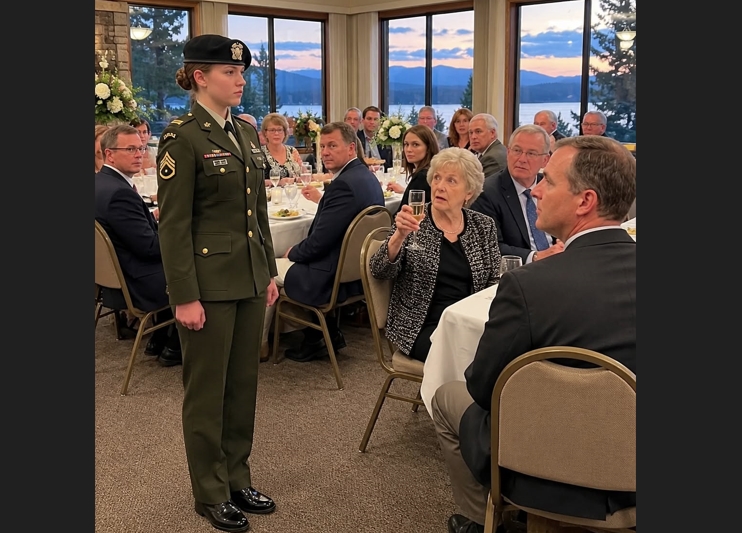
“Commander,” Josephine said.
One word. Clear enough to reach the kitchen doors.
The laughter thinned, then stopped. Across the room, my mother kept her glass raised, waiting for someone to explain the joke.
Josephine’s hand remained at her brow.
“Thank you, Jo,” I said gently. “You can lower your hand.”
Josephine lowered her hand, but remained at attention beside the white-clothed table. Her green Army dress jacket was neatly buttoned, her dark hair gathered beneath a black beret.
Beyond the tall windows, pink evening light stretched across the lake. Inside, every face had turned toward my niece.
Mom put down the microphone and sank into her chair. In her black-and-white patterned jacket, champagne still raised halfway to her mouth, she stared up at Josephine.
Barrett twisted around in his seat.
I remained near the kitchen doors in my simple navy dress, watching the youngest person in the room do what the rest of us had avoided for years.
“Aunt Francis commands a United States Navy attack submarine,” she said. “She just came home from seven months at sea.”
Somebody set down a fork. The small sound carried across the room.
Mom gave a short laugh.
“Josephine, honey. Your aunt has always had some sort of administrative—”
“I saw her command photograph.”
Josephine’s voice trembled now. I knew that tremor. Being afraid and continuing anyway.
“I showed Dad at Easter. He told me it was somebody else.”
She turned toward Barrett.
“Tell them what you told me.”
My brother’s face darkened.
“Sit down. This is your great-grandmother’s birthday.”
“Yes,” Grandma Otie said. “It is.”
She put her napkin beside her plate.
“And I would like to hear the answer.”
Barrett looked at me, then at his daughter.
“I recognized the picture,” he muttered.
I had spent years imagining how it might feel if my family finally learned what I did. In those imaginary conversations, I always felt vindicated.
Instead, looking at my brother, I felt tired.
“You knew?”
He rubbed his forehead.
“I didn’t think we needed to make a big production of it.”
Josephine swallowed.
“I only asked if it was her.”
Mom lowered her champagne glass.
“Well, Francis never tells us anything. How were we supposed to know?”
A few relatives shifted in their chairs. I recognized the opening she was offering them. We could all agree this was a misunderstanding, cut the cake, and go home.
I stood. My hand closed around the back of my chair.
Then I let go.
“You knew I was in the Navy, Mom.”
“You said you couldn’t discuss your work.”
“Certain operations. I could always tell you that I was serving. I did tell you. You kept saying I needed to find a real career.”
“You hardly ever came home.”
“I know.”
That stopped her more effectively than an argument would have.
“I missed things I can never get back. I missed Grandpa’s funeral. I read the message afterward, and there was nowhere I could go to be alone.”
My throat tightened. I waited until I could speak evenly.
“I understand being hurt by my absence. But you stood up tonight and invited everyone to laugh at me.”
Mom glanced toward the tables.
“It was a toast.”
“Then tell me what you were celebrating.”
She looked down at her glass.
Grandma pushed back her chair.
“Loretta, bring that empty chair over here.”
My aunt immediately stood.
“Francis,” Grandma said, “come sit beside me.”
As I crossed the room, nobody clapped. I was grateful for that. I could not have borne another performance.
Grandma took my hand and rubbed her thumb over my knuckles.
“I have your photograph on my mantel,” she told me. “I show it to anyone who stays long enough to look.”
Then she looked at the relatives nearest her.
“I should have spoken up more often when this foolishness started. I’m speaking now.”
Mom folded her hands on the table.
“Apparently everyone has decided I’m a terrible mother.”
The old instinct rose so quickly that I nearly obeyed it. Comfort her. Explain her intentions. Make the room easy again.
I could almost feel the broom in my hands.
“I’m asking you to stop insulting me,” I said. “You can answer that without asking me to comfort you.”
Her eyes filled.
Mine did too.
For once, I let both things be true.
Grandma squeezed my hand.
“Now,” she said, “I have waited ninety years for this particular birthday cake. Somebody bring it over before we all turn ninety-one.”
A small, relieved laugh moved through the room.
The cake arrived. We sang. Grandma closed her eyes before blowing out the candles, and I stayed beside her the entire time.
Later, when people began collecting coats, Josephine found me on the terrace overlooking the lake.
“I’m sorry,” she said.
“For what?”
“Making everything about you. You looked like you wanted to disappear.”
I leaned against the railing.
“I’m used to keeping things manageable. Sometimes I confuse that with keeping them right.”
She nodded, studying the dark water.
“When I found your command photograph online, I was so excited. I wanted to tell everyone you were my aunt.”
I looked away for a moment.
All those years of empty chairs, and somewhere, without my knowing it, a girl had been proud to belong to me.
“You could have called,” I said.
“I thought you’d be too important. Or too busy.”
“Sometimes I’ll be unreachable. That doesn’t mean I don’t want to hear from you.”
She smiled, then hesitated.
“Sometimes I worry I’ll spend my whole Army career trying to impress Dad.”
“I know how exhausting that can be.”
“What if I never do anything important enough for him?”
I reached for her hand.
“You deserve a place at your family’s table already, Jo. You don’t have to bring an impressive job title with you.”
She looked down at our hands.
“So do you,” she said.
The terrace door opened behind us.
Barrett stood there with his coat over one arm.
Josephine stiffened.
“Your grandmother’s looking for you,” he told her.
She glanced at me. I nodded, and she went inside.
Barrett took her place at the railing.
For a while, he said nothing.
Then, quietly, “She was asking all these questions about you. I couldn’t answer any of them.”
“So you told her she was wrong.”
He nodded.
“It was easier than admitting how little I knew about my own sister.”
The honesty hurt. It also gave us somewhere to begin.
“Tell Josephine that,” I said. “She deserves to hear it.”
“And you?”
“I need you to stop letting Mom’s version be the only one you’re willing to hear.”
He looked through the windows toward our mother.
“She won’t make that easy.”
“I know.”
He nodded again, slowly this time, and went back inside.
Mom waited until I was alone near the coatroom.
Without the microphone, she seemed unsure how to begin.
“You embarrassed me.”
I pulled my coat from its hanger.
She watched me put it on.
“Francis. Please.”
I stopped.
Her voice dropped.
“When your father died, I thought you’d stay.”
“I know you did.”
“Barrett was nearby. You were always somewhere I couldn’t reach.”
For the first time that evening, I could hear the grief underneath her anger. It was old grief, but I recognized it.
“I lost him too, Mom.”
She pressed her lips together.
“I sat in the driveway the day I left for college. I waited for you to come outside.”
“I couldn’t watch you go.”
“I needed you to try.”
A server passed us carrying a tray of empty glasses. We stepped aside, and the ordinary movement steadied me.
“I can’t keep coming home to be punished for leaving,” I said.
“What do you want me to do?”
“Correct what you said tonight. With the people who heard it.”
She looked back toward the dining room.
“There are hardly any people left.”
“You have their numbers.”
She studied my face, perhaps waiting for me to soften the request.
I kissed Grandma goodbye, promised to call, and left.
Three days later, an email arrived.
My mother had copied the family mailing list.
I opened it expecting a paragraph about misunderstandings.
Instead, the first sentence read: “What I said about Francis at Mother’s birthday was cruel and untrue.”
She wrote that I had continued serving all those years. That she had treated my absences as proof I didn’t care. That she had made jokes she now understood other people had taken as facts.
She included my rank once.
The sentence I read twice came near the end.
“I would owe my daughter this apology whatever job she had.”
I sat at my kitchen table for a long time.
Then I replied.
“Thank you for sending this. I can talk Sunday.”
That conversation lasted seventeen minutes.
We talked about Grandma’s roses and the weather. Mom asked whether I had been sleeping well since coming home.
I told her the truth.
“Better now.”
Things changed unevenly after that.
When she made a familiar little remark, I named it. Once, I ended a call. The next evening, she called back and apologized for the remark itself, without explaining what I should have understood.
Barrett apologized to Josephine. A week later, he sent me a message asking whether we could start over.
“We can start here,” I wrote.
Four months after the birthday, I returned to Minnesota for a short visit.
Grandma invited everyone to dinner. There were seven of us around her kitchen table, with mismatched plates and a roast that had stayed in the oven a little too long.
Josephine called because her schedule had changed and she couldn’t come.
Mom picked up the phone.
I watched her face as she listened.
“That’s disappointing,” she said.
Then she paused.
“But we’re glad you called. Tell us how you’re doing.”
Grandma caught my eye over the gravy boat.
Neither of us said anything.
After dinner, I found my old commissioning card tucked beside the photograph on her mantel. She had kept a copy of what she had written me.
“Go see what you can do, Frankie. Send postcards.”
I touched the edge of the frame, then returned to the kitchen to help her put away the dishes.
When it was time to leave, Mom followed me outside.
She stood beside my car while I put my bag in the back seat.
“Let me know when you arrive,” she said.
“I will.”
She hugged me, awkwardly at first, then held on.
I hugged her back.
At the end of the driveway, I looked in the rearview mirror.
My mother was still there, beneath the porch light, waving.
I lifted my hand and waved back.