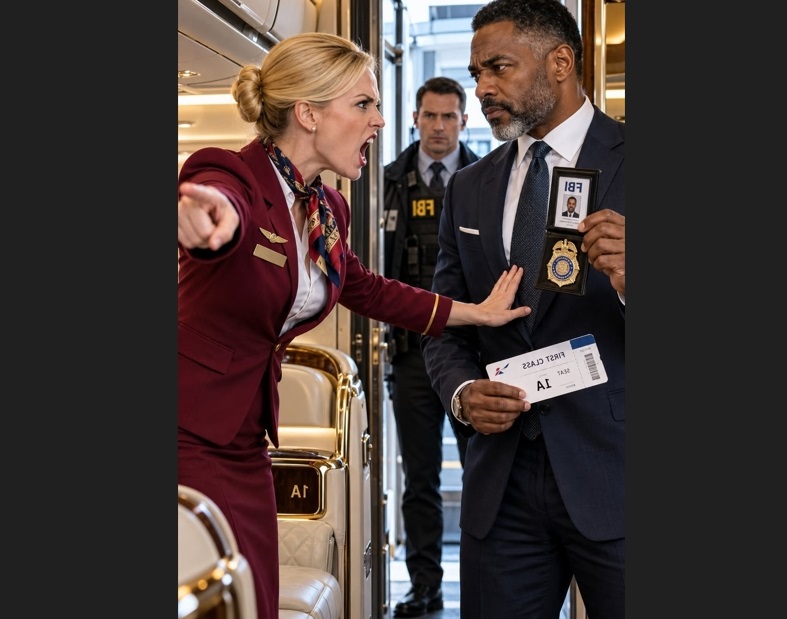
“Sir, I’ve already explained the situation,” she said sharply. “You can leave voluntarily, or I can have airport security escort you out.”
Raymond Carter remained seated.
“Then call your supervisor,” he replied calmly. “And please make sure the captain is informed.”
Patricia stared at him.
“You seem to think you’re in a position to give orders.”
“No, Ms. Langley. I’m asking you to follow the proper procedure.”
A few passengers exchanged uncomfortable glances.
The elderly woman sitting across the aisle finally spoke.
“Excuse me, but I watched this gentleman board. He hasn’t caused any trouble.”
Patricia turned toward her.
“Ma’am, this is an airline matter. Please remain seated.”
The woman frowned.
“Then perhaps the airline should explain why a paying passenger is being treated this way.”
Patricia ignored her.
She reached for the intercom near the galley.
“Ground security to Flight 728. We have a passenger refusing crew instructions.”
Raymond slowly raised his eyes.
“That’s an inaccurate description of what happened.”
Patricia looked back at him.
“Are you questioning my report?”
“I’m asking you to tell the truth.”
For the first time, her composure cracked.
“Sir, I have worked for this airline for seventeen years. I know exactly how to handle passengers like you.”
The words lingered in the cabin.
Passengers like you.
Raymond looked at her for several seconds.
Then he asked a simple question.
“What exactly do you mean by that?”
Patricia said nothing.
And that silence would soon become the most uncomfortable moment of her career.
The Security Officer Arrives
Three minutes later, an airport security officer appeared at the aircraft entrance.
Behind him stood a gate supervisor named Michael Benson.
Patricia immediately approached them.
“Thank goodness you’re here,” she said. “This passenger has been difficult since boarding. I’ve instructed him to leave, but he refuses.”
Benson looked toward seat 3A.
“Sir, I’m going to need you to step into the jet bridge.”
Raymond stood slowly.
Before moving, he placed his boarding pass on the armrest.
“Mr. Benson, can you confirm whether this ticket is valid?”
The supervisor examined it.
“Yes, sir. Your reservation is confirmed.”
“Have I threatened anyone?”
“No, sir.”
“Have I refused a lawful safety instruction?”
Benson hesitated.
“According to the flight attendant, you’ve refused to leave.”
Raymond nodded.
“But she hasn’t provided a reason for removing me.”
Patricia stepped forward.
“I don’t have to justify every decision to a passenger!”
The younger flight attendant near the galley suddenly spoke.
“Actually, Patricia, I think we should hear him out.”
Every head turned.
Her name was Emily Foster.
She had worked for Capital Sky Airways for only eight months.
Patricia stared at her.
“Emily, this doesn’t concern you.”
Emily swallowed nervously.
“I was here when it started. Mr. Carter showed his boarding pass. He was polite the entire time.”
“That’s enough,” Patricia snapped.
But Emily continued.
“And I heard you tell the gate agent earlier that you didn’t think he belonged in first class.”
A shocked murmur spread through the cabin.
Patricia’s face reddened.
“You’re a junior employee. Be careful what you say.”
Raymond looked at Emily.
“Thank you for being honest.”
Then he collected his briefcase.
“I’ll step outside, Mr. Benson. But I’d like the incident documented accurately.”
Patricia crossed her arms.
“Finally.”
She turned toward the other passengers.
“Thank you for your patience, everyone. We can now prepare for departure.”
She believed the matter was finished.
She was wrong.
The Men in Dark Suits
Raymond had taken only three steps into the jet bridge when he heard hurried footsteps approaching from the terminal.
Four people appeared around the corner.
Three men in dark suits.
And a woman carrying a secured government briefcase.
They moved quickly, their attention fixed on the man standing outside the aircraft.
The tallest agent stopped immediately.
“Director Carter?”
Raymond turned.
“Agent Mitchell.”
The man straightened.
“Sir, we’ve been trying to reach you. There’s been an important development. We need to update you before you depart.”
Raymond glanced toward the aircraft.
“That may not be a problem. Apparently, I’m no longer welcome on this flight.”
Agent Mitchell looked confused.
“Excuse me, sir?”
Before Raymond could answer, Patricia appeared at the aircraft doorway.
“Sir, I told you to leave the boarding area. You cannot stand here delaying—”
She stopped.
Agent Mitchell had opened his credentials.
The gold badge reflected the overhead lights.
FEDERAL BUREAU OF INVESTIGATION.
Patricia stared.
Then she noticed the other agents displaying their identification to the airport security officer.
Michael Benson stepped forward.
“Is there a problem, gentlemen?”
Agent Mitchell answered calmly.
“We need to speak with Director Raymond Carter.”
Benson looked toward Raymond.
“Director of what?”
The agent paused.
Then spoke clearly enough for everyone near the doorway to hear.
“The Federal Bureau of Investigation.”
Silence.
Absolute silence.
Patricia’s expression changed instantly.
Her mouth opened slightly.
She looked at Raymond.
Then at the badge.
Then back at Raymond.
“You’re… the FBI Director?”
Raymond said nothing.
Agent Mitchell answered for him.
“Yes, ma’am. Director Carter oversees the Bureau.”
Patricia gripped the doorway.
For seventeen years, she had prided herself on recognizing important passengers.
Corporate executives.
Politicians.
Celebrities.
Diplomats.
Yet the man she had just ordered off the aircraft held one of the nation’s most significant federal law-enforcement positions.
And she had never once asked who he was.
The Captain Steps Forward
The captain emerged from the cockpit after hearing the commotion.
“What’s happening here?”
Agent Mitchell introduced himself and explained that the FBI Director was traveling aboard Flight 728.
The captain looked stunned.
“Director Carter was removed from my aircraft?”
Raymond answered before Patricia could speak.
“Captain, your senior flight attendant informed me that my presence in first class had raised concerns. She refused to explain what those concerns were.”
The captain turned toward Patricia.
“Did he threaten anyone?”
“No, Captain.”
“Was his identification or boarding pass invalid?”
“No.”
“Was he disruptive?”
Patricia hesitated.
“He questioned my authority.”
The captain stared at her.
“Questioning a decision is not automatically misconduct.”
Emily stepped forward.
“Captain, I witnessed the conversation. Mr. Carter remained respectful throughout.”
The elderly passenger from seat 2C appeared behind her.
“So did I. He didn’t deserve any of this.”
Another passenger raised his hand.
“I recorded part of the exchange. I can provide it to the airline if necessary.”
Patricia looked around.
Suddenly, the cabin full of people she had expected to support her was speaking against her behavior.
The captain turned to Raymond.
“Sir, I sincerely apologize. Your seat is yours, and you are welcome aboard.”
Raymond nodded.
“Thank you, Captain.”
Patricia stepped forward, visibly shaken.
“Director Carter, I had absolutely no idea who you were.”
Raymond looked directly at her.
And asked a question she would never forget.
“Would knowing my title have changed how you treated me?”
Patricia lowered her eyes.
“Of course, sir.”
Raymond’s expression remained serious.
“Then that’s the problem.”
Nobody spoke.
“You believed I deserved respect only if I held a position you considered important.”
He paused.
“But I deserved respect before you knew anything about me.”
The Decision Nobody Expected
Agent Mitchell quietly approached Raymond.
“Sir, the updated briefing is ready. We can arrange another flight if necessary.”
Raymond looked toward the aircraft.
For a moment, everyone expected him to demand Patricia’s immediate dismissal.
He had the attention of the captain, airport management, and four federal agents.
Instead, he did something nobody anticipated.
He turned toward Emily Foster.
“Young lady, may I ask you something?”
“Yes, sir.”
“Were you worried about speaking up?”
Emily hesitated.
“Yes, sir. Patricia is my senior, and I’m still new.”
“Then why did you do it?”
Emily glanced toward the aircraft.
“Because I saw something wrong. And I didn’t think staying silent was right.”
Raymond smiled for the first time.
“That’s the kind of judgment people in positions of responsibility should have.”
Then he turned toward the captain.
“I don’t want special treatment, and I’m not asking anyone here to make a decision out of fear of my position.”
He nodded toward Patricia.
“But I do expect this incident to be reviewed fairly, including the statements from the passengers and the junior crew member.”
The captain agreed.
“Absolutely, sir. I will personally submit a report.”
Michael Benson added that airport management would preserve the relevant records.
Patricia’s hands trembled.
“Director Carter, please. I have a family. I’ve given seventeen years to this airline.”
Raymond looked at her quietly.
“Ms. Langley, I’m not the person who decides your employment.”
She appeared relieved.
Then he continued.
“But seventeen years of experience should have taught you that authority comes with responsibility.”
Her eyes filled with tears.
“I made a terrible mistake.”
“Yes,” Raymond said. “You did.”
He paused.
“And I hope you understand that the mistake wasn’t failing to recognize an FBI Director.”
He gestured toward the passengers watching from inside.
“It was deciding that someone didn’t belong before giving him a fair chance to speak.”
Six Weeks Later
Flight 728 departed that afternoon with a different senior flight attendant assigned to the cabin.
Raymond Carter took another flight after completing the urgent briefing with his agents.
He never requested special punishment for Patricia.
But the airline’s internal review uncovered more than one troubling incident.
Several passengers had previously complained about Patricia’s dismissive treatment.
Those complaints had not been adequately addressed.
This time, the witnesses, crew statements, and available recordings told a consistent story.
Patricia had demanded that a passenger surrender a valid first-class seat without identifying a legitimate reason.
The airline ultimately terminated her employment after completing its disciplinary process.
It also introduced new reporting procedures and additional training for cabin crews.
Emily Foster received a commendation for her professionalism.
But the most surprising development came two weeks later.
A handwritten letter arrived at Raymond Carter’s office.
It was from Patricia.
She did not ask for her job back.
Instead, she wrote about something that had happened during her final week at the airline.
She had watched an elderly passenger struggle with a suitcase.
The woman wore inexpensive clothes and appeared nervous about boarding.
Patricia admitted that her first instinct had been to assume the woman would cause trouble.
Then she remembered Raymond’s question.
Would knowing my title have changed how you treated me?
She had stopped herself.
Helped the woman with her bag.
And walked her to her seat.
The elderly passenger had smiled and whispered, “Thank you for treating me like I matter.”
Patricia wrote that those words affected her more deeply than any reprimand.
At the bottom of the letter, she added:
“I spent seventeen years believing I could recognize an important person. You taught me that I shouldn’t have to recognize importance before showing kindness.”
Raymond read the letter twice.
Then he placed it inside the same thin folder he had carried on Flight 728.
He did not celebrate Patricia losing her position.
He hoped she had learned something that would stay with her.
A few days later, Emily received a small envelope at the airline’s headquarters.
Inside was a handwritten note from Raymond.
It contained only three sentences.
“Thank you for choosing the truth when silence would have been easier. Never allow someone’s title to determine whether you speak up for what is right. Your courage mattered long before you knew who I was.”
Emily framed the note.
Years later, she would still keep it beside her desk.
Not because it came from the FBI Director.
But because it reminded her of the day she learned what real courage looked like.
And Raymond Carter never forgot the lesson either:
A person’s dignity does not come from a badge, a title, a first-class ticket, or an expensive suit. It is something every human being deserves from the beginning.
Because the true test of character is not how you treat someone powerful. It is how you treat someone when you believe they have no power at all.
THE END.