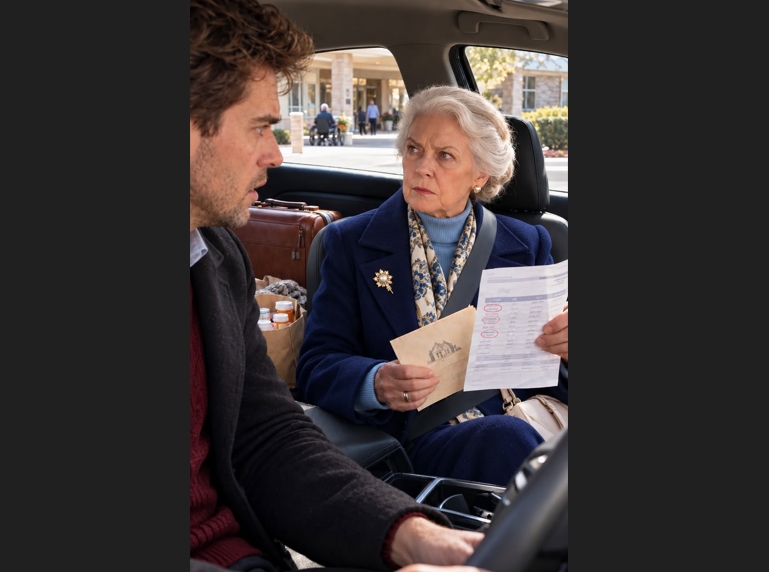
“They were getting me out of the way.”
Grandma Eleanor’s words stayed with me as we pulled into the county courthouse parking lot.
I turned off the engine.
“Grandma, what exactly do you think they did?”
She looked down at the envelope containing my grandfather’s handwriting.
“I think your father tried to steal my house.”
For a moment, neither of us spoke.
My grandmother had lived in that house for forty-three years. My grandfather had built the back porch himself. Every Christmas, every birthday, every Sunday dinner I remembered had happened beneath that roof.
And now my own parents might have taken it from her.
“Come on,” she said, opening her door. “Let’s find out.”
Inside the courthouse, we requested the property’s most recent recorded documents.
The clerk searched the records.
Then she frowned.
“There was a deed transfer recorded three days ago.”
My grandmother went completely still.
“Transferred to whom?” I asked.
The clerk printed the document.
The property had been transferred from Eleanor Mercer to a company called Mercer Family Holdings LLC.
I recognized the company immediately.
My father had registered it two years earlier.
Then I saw the signature.
Eleanor Mercer.
Grandma studied the page.
“That isn’t my signature.”
My throat tightened.
The document claimed she’d signed away her house for ten dollars and other consideration.
The home was worth nearly $340,000.
“Can this be reversed?” I asked.
The clerk explained that she couldn’t decide whether the document was fraudulent. We would need an attorney to challenge it.
Grandma folded the paper carefully.
“Good,” she said. “Now we know.”
But her hands were shaking.
I had never seen her afraid before.
At the bank, things became worse.
Because Grandma was the account holder, the branch manager agreed to review the transactions with her.
The three withdrawals totaled $55,000.
And all three had gone to accounts connected to my father’s company.
The manager examined the paperwork.
“Mrs. Mercer, were you aware these transfers were being made?”
“No.”
“Did you authorize your son to use this money for his business?”
“Absolutely not.”
The manager’s expression changed.
He explained that the bank would open a fraud investigation and review the power-of-attorney documents. Grandma signed instructions revoking my father’s authority, and the manager began the necessary account-protection procedures.
Then he showed us something else.
Two weeks earlier, my father had requested information about liquidating Grandma’s remaining investments.
Nearly $180,000.
I felt sick.
“He was going to take everything.”
Grandma looked at the manager.
“Please make copies of everything.”
Outside, I finally lost my composure.
“We need to call the police.”
“We will,” she answered.
“Then why are we still driving to your house?”
She looked at me with an expression I couldn’t understand.
“Because I need to see what’s left.”
Twenty minutes later, we turned onto her familiar street.
I nearly drove past the house.
A large dumpster stood in the driveway.
Several cardboard boxes were stacked on the front porch.
And a real estate sign stood in the yard.
SALE PENDING.
Grandma stared through the windshield.
Then she whispered something that broke my heart.
“Your grandfather planted those roses.”
The rosebushes along the front walk had been torn out.
I parked.
Before I could stop her, Grandma opened the passenger door and walked toward the house.
Inside, strangers were carrying furniture.
A man holding a clipboard approached us.
“Can I help you?”
“Yes,” Grandma replied. “Why are you removing my belongings?”
The man hesitated.
“Your son arranged the estate clearance. We were told the previous owner had moved into permanent care.”
“Permanent care?”
Her voice sharpened.
“I’m standing right here.”
The man lowered his clipboard.
I showed him her identification and explained that the property transfer was being disputed.
He immediately stopped the workers and contacted his supervisor.
Then we heard a car pull into the driveway.
My father’s silver SUV.
Both my parents climbed out.
Dad stopped when he saw us.
Mom’s face went pale.
“Daniel,” she said. “What are you doing here?”
I couldn’t believe she had the nerve to ask.
“What am I doing here? You left Grandma at a nursing home without even finishing the admission paperwork!”
Dad marched toward us.
“You don’t understand the situation.”
“Then explain it,” Grandma said.
He stopped.
For several seconds, he wouldn’t look at her.
Finally, he spoke.
“Mom, the house was too much for you. We were trying to make responsible decisions.”
Grandma held up the courthouse document.
“Did you make this decision too?”
His eyes dropped to the paper.
I watched the color drain from his face.
Mom immediately stepped forward.
“Eleanor, please. We can talk about this privately.”
“We’re talking now.”
Dad rubbed his forehead.
“The company was in trouble,” he admitted.
There it was.
The truth.
His construction business had been losing money for months. He’d borrowed against equipment, missed payments, and apparently run out of options.
He needed cash.
And Grandma’s savings and house were his solution.
“I was going to put everything back,” he insisted. “Once the next contracts came through—”
“You took fifty-five thousand dollars,” she interrupted.
Dad said nothing.
“And you transferred my home without my permission.”
“I thought you’d understand.”
Grandma took one step closer.
“Did you think I’d understand being left in a strange building with one suitcase?”
Mom began crying.
“We didn’t know what else to do.”
Grandma looked at her.
“You could have asked for help.”
Then she turned back to my father.
“You could have told me you were drowning. Instead, you decided to push me underwater.”
Nobody answered.
Then Grandma said something I will never forget.
“I raised you in this house. I taught you to tell the truth at this kitchen table. And today, you used the trust I gave you to take away the only place I have left.”
Dad’s expression crumpled.
“Mom, I’m sorry.”
She shook her head.
“Sorry doesn’t put my name back on the deed.”
That afternoon, we contacted an attorney experienced in elder financial exploitation.
He reviewed the documents, helped Grandma report the suspected fraud, and began preparing an emergency court request to stop any further sale or transfer of the property.
The pending sale didn’t close.
The bank investigation continued.
And the documents my father had signed became the subject of a criminal investigation.
But before we left that day, Grandma asked me to follow her upstairs.
Her bedroom had been emptied.
The quilt she’d sewn with my grandfather was folded inside a cardboard box.
She opened the closet and reached behind a loose wooden panel.
From the space behind it, she removed a small metal tin.
Inside were photographs, letters, and my grandfather’s wedding ring.
Then she took out one photograph.
It showed my father at about eight years old, sitting on my grandfather’s shoulders beneath the old oak tree.
Grandma stared at it for a long time.
“He wasn’t always like this,” she whispered.
I didn’t know what to say.
She placed the photograph back inside the tin.
Then she looked at me.
“Promise me something, Daniel.”
“Anything.”
“Don’t become so angry with them that it changes the kind of man you are.”
My eyes filled.
“They don’t deserve your forgiveness.”
“Perhaps not,” she said. “But you deserve to live without their mistakes poisoning your heart.”
That night, Grandma came home with me to Indianapolis.
Not to a nursing home.
Not to another place chosen by somebody else.
To my apartment, where she had her own bedroom, her favorite blue blanket, and a key to the front door.
Over the following months, the legal proceedings were exhausting.
With the attorney’s help, Grandma challenged the deed, and the court eventually ordered the fraudulent transfer set aside.
Some of the missing money was recovered, though not all of it.
My father faced legal consequences for his actions. My mother was also questioned about her involvement.
Their business collapsed.
For the first time in their lives, they had to face problems they couldn’t solve by taking something from someone else.
Six months later, Grandma and I stood on the porch of her house.
The ownership dispute had finally been resolved.
The locks were changed.
The roses were gone, but the oak tree still stood.
“Are you ready to move back?” I asked.
She smiled.
“Not quite.”
I looked at her.
“What do you mean?”
She handed me a folder.
Inside was a letter from her attorney confirming that she had updated her estate documents.
I stared at the papers.
“Grandma, you don’t have to leave me the house.”
“I know.”
“Then why?”
She took my hand.
“Because you were the only person who came when I had nothing to offer.”
I shook my head.
“I would have come anyway.”
Her eyes glistened.
“I know, sweetheart. That’s exactly why.”
Then she surprised me.
“I don’t want to live here alone anymore. The house is yours to care for someday, but for now, I’d rather stay near you.”
I laughed through my tears.
“You’re welcome to stay as long as you want.”
She squeezed my hand.
“Good. Because your kitchen needs serious attention.”
For the first time in months, we both laughed.
A year after that terrible afternoon, Grandma turned eighty-two.
We celebrated in my backyard.
There was cake, music, and a ridiculous number of balloons.
Halfway through dinner, she raised her glass.
“I want to say something.”
Everyone went quiet.
“Last year, I thought my life was being taken away from me. My money. My home. My choices.”
She looked toward me.
“But my grandson reminded me that getting older doesn’t mean becoming invisible.”
Then she smiled.
“And I’ve learned something else. Family isn’t measured by who stands beside you when there’s something to inherit.”
Her voice trembled slightly.
“It’s measured by who drives 190 miles when all you have left is a suitcase.”
I couldn’t speak.
Later that evening, after everyone had gone, Grandma sat beside me on the porch.
“Daniel?”
“Yeah, Grandma?”
“Do you remember what I told you when you picked me up?”
I smiled.
“Don’t call them. I’ll tell you where to drive.”
She nodded.
“Do you know why I said that?”
“Because you knew they’d stolen your house?”
“No.”
She looked at the stars.
“Because I was afraid that if I heard your father’s voice, I’d start crying. And once I started, I didn’t know if I’d ever stop.”
I reached for her hand.
She held it tightly.
“Thank you for coming,” she whispered.
“Always, Grandma.”
She smiled.
And at that moment, I finally understood.
My parents thought they could leave an elderly woman behind, take everything she owned, and quietly move on with their lives.
But they had forgotten one important thing.
Grandma Eleanor hadn’t lost her voice, her dignity, or her right to decide her own future.
And the grandson they thought would stay out of their business became the person who helped her reclaim it.
Because a home is more than a deed, family is more than blood, and love is proven by the people who show up when you need them most.
THE END.