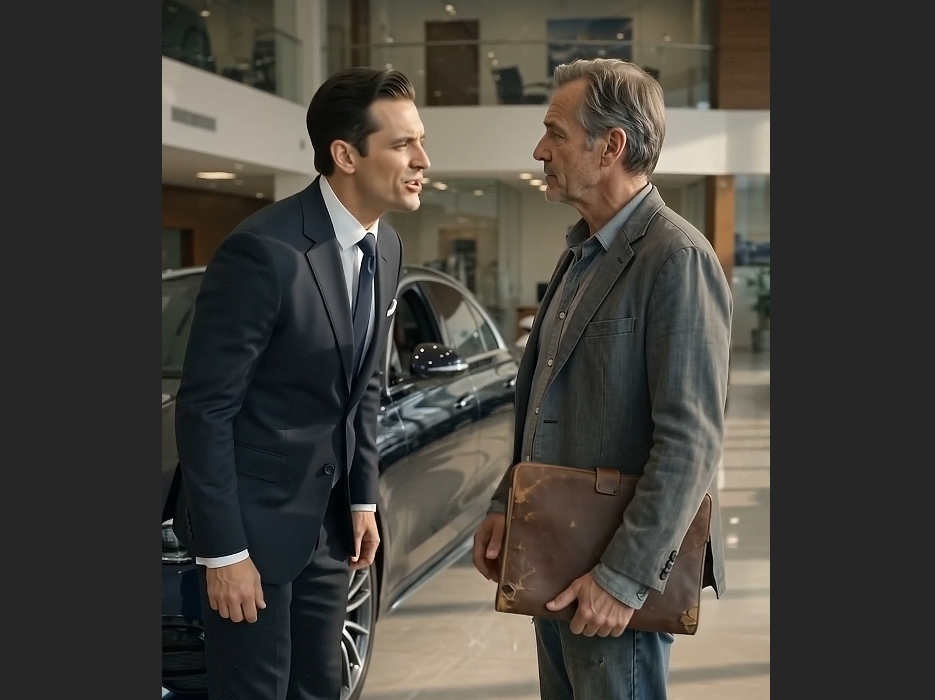
The luxury car showroom was designed to impress from the moment someone walked through the doors. Polished floors reflected rows of carefully displayed vehicles, bright lights highlighted every detail, and employees moved between customers preparing for another busy day.
That afternoon, an older man named Mr. Bennett quietly entered the showroom.
He wasn’t wearing an expensive suit or anything that suggested he was there for a special occasion. His gray jacket was simple and slightly worn, his jeans were ordinary, and under his arm he carried an old leather portfolio.
He slowly walked toward one of the vehicles and stopped beside it.
Before he could examine it for long, a salesman named Ryan approached.
“Sir, this showroom isn’t for window shopping,” Ryan said sharply.
Mr. Bennett turned toward him, surprised by the greeting.
“I came to buy a car,” he replied calmly.
Instead of asking what model interested him or whether he needed assistance, Ryan looked at the man’s clothes.
“Then you should have dressed like it,” he said. “You’re wasting my time.”
Mr. Bennett remained composed.
He could have immediately explained who he was, but instead he asked a simple question.
“Why do you think I’m wasting your time?”
Ryan gestured toward the expensive vehicles surrounding them.
“These cars cost more than most people’s houses.”
The implication was obvious. Ryan had already decided that the man standing in front of him couldn’t afford anything in the showroom.
Mr. Bennett studied him for a moment.
“You seem very certain you know what I can afford.”
Ryan didn’t reconsider.
“Look at you,” he replied. “Be realistic.”
For a few seconds, Mr. Bennett said nothing.
The conversation had stopped being about cars. It had become an example of what could happen when someone formed an opinion about another person without knowing anything about them.
Then a voice came from across the showroom.
“Ryan!”
Both men turned.
Daniel, one of the dealership’s senior managers, was walking quickly toward them.
“Step away from him. Right now.”
Ryan appeared confused.
“Daniel, I’m handling a customer that is not a customer.”
Daniel stopped beside them and stared at Ryan in disbelief.
“That is Mr. Bennett,” he said.
Ryan still didn’t understand why the name mattered.
Then Daniel finished the sentence.
“He owns this dealership.”
Ryan’s expression immediately changed.
The customer he had dismissed only moments earlier wasn’t someone who had accidentally wandered into an expensive showroom. He was the person responsible for the business Ryan was standing inside.
“Mr. Bennett, I…” Ryan began.
“I didn’t know.”
Mr. Bennett finally responded.
“That’s exactly the problem.”
His point wasn’t that Ryan should have recognized the dealership’s owner. It was that recognition should never have been necessary for basic courtesy.
“You judged the man before you knew the name,” Daniel told him.
Ryan looked down, realizing how differently he would have behaved if Mr. Bennett had arrived wearing an expensive suit or if someone had announced his identity at the door.
Mr. Bennett hadn’t entered the showroom hoping to embarrass anyone. In fact, he had deliberately visited without drawing attention to himself because he wanted to experience the dealership the way an ordinary customer would.
What he discovered concerned him.
A dealership could have beautiful cars, impressive architecture, and an expensive inventory, but none of those things could compensate for making a customer feel unwelcome.
Mr. Bennett looked directly at Ryan.
“Never judge a customer by the clothes on his back.”
The lesson extended far beyond one showroom.
People enter businesses carrying stories that aren’t visible from the outside. Someone wearing old clothes may have spent decades building a successful company. A quiet customer may be preparing to make the biggest purchase of their life. Another person may simply be browsing today and return months later ready to buy.
But even if none of those things are true, respect should remain the same.
Professional service shouldn’t depend on someone’s clothing, perceived wealth, age, job title, or social status.
Ryan had made his decision within seconds of seeing Mr. Bennett. He believed appearance told him everything he needed to know.
Instead, it revealed something about his own approach to customer service.
Mr. Bennett didn’t need special treatment because he owned the dealership. He expected the same standard of courtesy to be offered to everyone who walked through those doors.
Because sometimes the person who appears least important may have more influence than anyone realizes.
And even when they don’t, they still deserve to be treated with dignity.