This fictional story highlights the importance of patience, professionalism, and verifying facts before making assumptions.
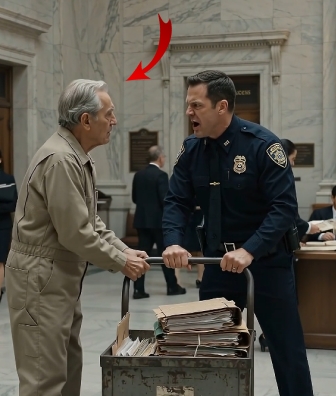
The courthouse corridor was busy as attorneys, employees, and visitors moved between offices. In the middle of the activity, an older court worker named Mr. Harris carefully pushed a metal cart loaded with sealed folders and a secure case.
Mr. Harris had followed the same controlled routine for many years. That morning, he was heading toward a restricted area when a police officer suddenly stepped in front of the cart.
“Stop. You can’t take that cart through here,” the officer declared.
Mr. Harris brought the cart to a halt. Rather than reacting angrily, he calmly explained that he had worked at the courthouse for decades and knew exactly where the materials needed to go.
The officer was not persuaded. He pointed toward the opposite end of the corridor and ordered Mr. Harris to turn around immediately.
Several court employees noticed the disagreement. Some slowed down to observe, but nobody interrupted. Mr. Harris remained composed as the officer reached for the cart.
“Please take your hands off my cart,” Mr. Harris said firmly.
The officer responded that Mr. Harris could not give him instructions. He warned that the older worker could be removed from the area if he refused to cooperate.
Mr. Harris did not raise his voice. Instead, he advised the officer to ask about the cart’s contents and confirm his credentials before touching anything. It was not an attempt to challenge authority. It was a reminder that courthouse security depended on everyone following established procedures.
However, the officer assumed he already understood the situation. He opened a metal container and saw sealed folders alongside a locked security box.
“What is this?” he asked, suddenly sounding less certain.
Mr. Harris held up his official identification badge. He explained that 29 years earlier, he had been assigned to help protect and transport some of the court’s most sensitive archived records. His modest work uniform did not reveal the importance of his responsibility, but his authorization was clear.
Before the officer could respond, the restricted doors opened. A judge stepped into the corridor with several court officials and immediately recognized what was happening.
“Officer, step away from that cart,” she instructed.
The hallway became quiet. The judge explained that Mr. Harris was the authorized employee responsible for transporting the sealed archives. His long record of careful service had earned the court’s complete trust.
The officer stepped back as the weight of his mistake became clear. He had been right to care about security, but he had acted before checking the available information. His confrontational approach had created an unnecessary disruption and could have compromised the very procedures he intended to protect.
The judge then turned toward Mr. Harris and asked whether the records were secure.
Mr. Harris adjusted his grip on the cart and answered calmly, “They are now.”
He continued through the restricted doors without celebrating the officer’s embarrassment. His response reflected the professionalism that had defined nearly three decades of service.
The encounter offers a valuable workplace lesson. Responsible security requires attention and caution, but it also requires respectful communication. A uniform, job title, or first impression never tells a person’s complete story.
Asking a simple question and checking identification can prevent confusion. More importantly, treating every colleague with dignity creates a safer and more professional environment for everyone.