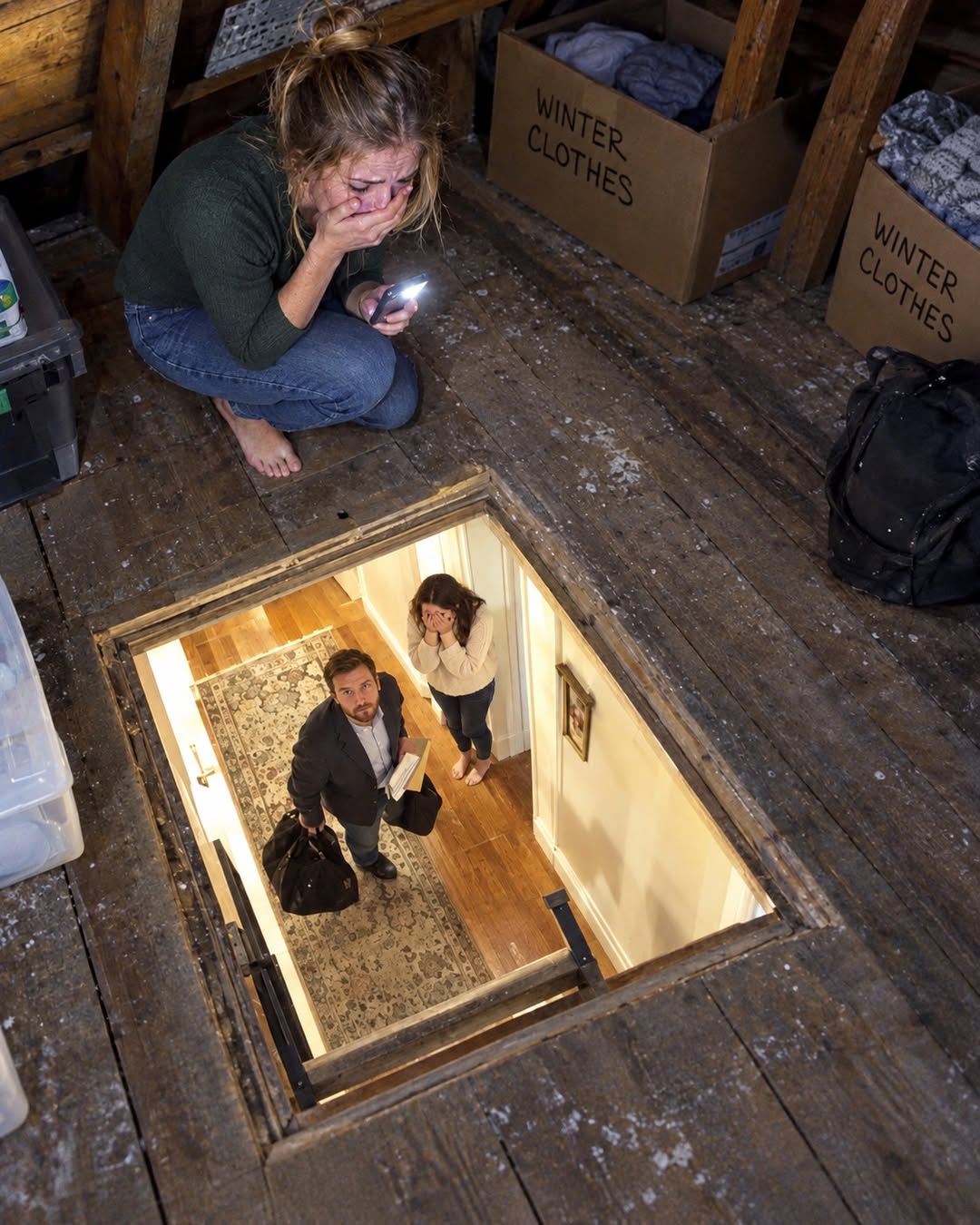
The third passport had my photograph.
But the name beneath it was not Elise Morrison.
It was Elena Voss.
I stared through the narrow gap between the attic floorboards, unable to breathe.
Caleb turned the passport over in his hands.
The stranger in the raincoat stood beside him, water dripping from his sleeves onto our hallway rug.
“Where is she?” the man asked.
Caleb glanced toward the stairs.
“She said she was getting water.”
“Then why is her phone off?”
“I don’t know.”
The stranger stepped closer.
“You told me she didn’t suspect anything.”
“She didn’t.”
“Your sister-in-law called her.”
Caleb’s face changed.
My heart stopped.
Mara.
They knew about Mara.
I pressed my hand over my mouth.
The stranger opened the case again.
“Then we have a problem.”
Caleb looked at the passports.
“What about Noah?”
“He’s still where you left him.”
“That’s not what I asked.”
The stranger’s voice hardened.
“We don’t have time for this.”
He reached into his coat and removed a folded document.
Caleb took it.
Through the crack, I saw a photograph attached to the first page.
Mine.
Beside it was another photograph.
Mara’s.
And beneath both photographs was a single printed word.
COMPROMISED.
My name is Elise Morrison.
I was thirty-four years old, married for nine years, and the mother of a four-year-old boy who believed his father could fix absolutely anything.
Until that night, I had believed something similar.
Caleb was the calm one in our marriage.
When the washing machine flooded the laundry room, he found the shutoff valve before I found a towel.
When Noah developed a fever, Caleb stayed awake beside his bed.
When my father died, Caleb handled the funeral arrangements because I could barely remember how to answer the phone.
He worked in corporate logistics, a job that involved long hours, complicated shipments, and occasional travel.
I never understood every part of it.
I had never thought I needed to.
Marriage, I believed, meant trusting someone with the ordinary parts of your life.
Your keys.
Your schedule.
Your sleeping child.
The person beside you in bed.
Now I was crouched in our attic, watching my husband examine three passports bearing names I had never heard.
And the man beside him knew my sister had called.
I backed away from the floorboards.
My phone was still in my hand.
The screen was dark.
Mara had told me to turn it off.
But she had also told me not to hang up.
The call had ended anyway.
I wanted to call her back.
I wanted to call the police.
I wanted to run downstairs and demand an explanation.
Instead, I heard Caleb say, “She wouldn’t leave Noah.”
The stranger answered, “Then she’ll do what we need.”
I stopped moving.
There was a reason Noah was spending the weekend with Caleb’s parents.
At least, there was the reason Caleb had given me.
His mother, Judith, had called on Thursday to say she missed her grandson.
She wanted to take him to a children’s museum, bake cookies, and let him sleep in the little bedroom she had decorated with dinosaur wallpaper.
Caleb had encouraged it.
“We could use a weekend together,” he said.
I remembered smiling.
A weekend without cartoons before sunrise.
Without plastic dinosaurs underfoot.
Without someone asking for a snack five minutes after dinner.
I had packed Noah’s blue overnight bag.
I had kissed his forehead.
And I had watched Caleb drive him away.
Now the stranger downstairs was talking about my son as though he were a piece of luggage.
I crawled toward the attic’s back wall.
There was a small storage cabinet beneath the sloping roof.
Behind it, years earlier, Caleb had installed an access panel to reach the wiring.
I knew because I had helped him paint the cabinet afterward.
I pulled it aside as quietly as I could.
The panel was still there.
My fingers found the edge.
Then footsteps sounded on the stairs below.
“Elise?”
Caleb.
I froze.
“Elise, where are you?”
His voice was closer now.
He was on the second floor.
I pushed the cabinet back into place.
“Elise?”
A pause.
Then I heard the attic stairs creak.
He was coming up.
The latch on the attic door rattled.
“Elise?”
I stared at it.
Caleb tried the handle again.
“Why is this locked?”
I forced myself to speak.
“I thought I heard something.”
There was a silence.
“What?”
“Outside. I thought someone was in the yard.”
The handle stopped moving.
Then Caleb said, “Open the door.”
I looked toward the floorboards.
“I don’t feel well.”
“Elise.”
His voice changed.
Not louder.
Colder.
“Open the door.”
I backed away.
“I need a minute.”
Another silence.
Then I heard him turn.
For one hopeful second, I thought he was leaving.
Instead, he said, “She’s up here.”
The stranger answered from below.
“Keep her there.”
My knees nearly gave way.
Caleb spoke again.
“Elise, listen to me. Whatever Mara told you, she doesn’t understand what’s happening.”
I closed my eyes.
He knew.
He knew she had warned me.
“What is happening?” I asked.
“We need to talk.”
“Then talk.”
He lowered his voice.
“Not through a door.”
I looked at the latch.
Then at the storage cabinet.
And I understood that the next decision I made might determine whether I ever saw Noah again.
I had known Mara was worried about Caleb.
Not frightened.
Not like this.
But worried.
Three weeks earlier, she had come to our house for dinner.
Caleb was away on business.
Noah had fallen asleep on the couch with a toy truck in his hand.
Mara helped me carry him upstairs.
Then she stood in the hallway, looking at a framed photograph of our family.
“Does Caleb still travel for work as much as he used to?”
I shrugged.
“More, lately.”
“Where?”
“Baltimore. Richmond. Sometimes overseas.”
She nodded.
“Does he tell you what he’s doing?”
I laughed.
“Something involving shipping contracts. You know how he is.”
Mara did not laugh.
“Has he asked you to sign anything recently?”
I thought about it.
“No. Why?”
She looked toward Noah’s room.
“Just checking.”
I remember feeling irritated.
Mara worked for the FBI, and sometimes she brought that habit home.
She could turn an ordinary conversation into an interview without seeming to notice.
“Mara, if you’re asking whether my husband is having an affair, just ask.”
She shook her head.
“That’s not what I’m asking.”
“Then what are you asking?”
She hesitated.
“Has he talked about moving?”
I frowned.
“No.”
She nodded.
Then she changed the subject.
I had forgotten the conversation.
Now, crouched in the attic, I remembered every word.
Caleb knocked again.
“Elise, I know you’re scared.”
I stared at the door.
“Where’s Noah?”
“He’s with my parents.”
“Is he safe?”
“Yes.”
“Then call him.”
A pause.
“What?”
“Call your mother. Put Noah on the phone.”
“Elise, it’s after midnight.”
“I know what time it is.”
He exhaled sharply.
“We don’t have time for this.”
I felt cold.
Those were the stranger’s words.
Exactly.
“Who is downstairs?”
Caleb did not answer.
“Caleb?”
“Someone helping me.”
“With what?”
He lowered his voice.
“Getting us out.”
I stared at the door.
“Out of what?”
A long silence.
Then he said, “I made a mistake.”
I almost laughed.
A mistake.
He had three passports with false names.
A stranger was standing in our hallway.
My sister had ordered me to hide.
And my husband was calling it a mistake.
“What did you do?”
Caleb said nothing.
Then the stranger’s voice came from the bottom of the attic stairs.
“Enough.”
The floor creaked.
He was coming up.
My phone vibrated.
I nearly dropped it.
The screen lit for a fraction of a second.
A message.
Unknown number.
Stay hidden. Do not open the door.
I stared at it.
Another message appeared.
We are nearby.
Mara.
It had to be Mara.
I wanted to believe that.
Then I remembered the stranger knew she had called.
What if the message was from him?
What if they wanted me to move?
I turned the screen facedown.
The stranger reached the attic landing.
I heard him speak quietly to Caleb.
Then Caleb said, “Elise, I’m going to explain everything.”
I did not answer.
He continued.
“Someone I worked with got involved in something illegal. I didn’t know how serious it was until recently.”
The stranger said something I couldn’t hear.
Caleb paused.
Then he continued.
“There are people looking for us.”
I stared at the door.
“Who?”
“Elise, please.”
“Who is looking for us?”
He said nothing.
The stranger spoke.
“Tell her about the boy.”
Caleb’s voice sharpened.
“Don’t.”
My stomach dropped.
Noah.
I moved toward the door before I could stop myself.
“What about Noah?”
Caleb answered quickly.
“Nothing. He’s fine.”
The stranger said, “Then open the door and let’s finish this.”
I stepped back.
And for the first time, I understood that Caleb was not the only person I needed to fear.
The stranger’s phone rang.
He answered immediately.
I heard only his side of the conversation.
“Yes.”
A pause.
“No, she’s still here.”
Another pause.
Then his voice changed.
“What do you mean?”
He moved away from the attic door.
Caleb followed him.
Their footsteps retreated down the stairs.
I crawled back to the floorboards.
The stranger stood in the hallway, holding his phone close to his ear.
Caleb was beside him.
“What’s wrong?” Caleb asked.
The stranger ended the call.
“Your parents aren’t answering.”
Caleb frowned.
“What?”
“Neither number.”
He reached for his own phone.
I watched him dial.
Wait.
Dial again.
Then his face drained.
“Mom?”
No answer.
He tried another number.
“Dad?”
Nothing.
The stranger looked toward the front door.
“We’re leaving.”
Caleb shook his head.
“Not without Elise.”
“She’s not the priority anymore.”
Caleb grabbed his arm.
“My son is out there.”
The stranger pulled away.
“Then you should have followed instructions.”
I pressed my forehead against the floor.
Something was happening at Judith’s house.
Something neither man had expected.
I wanted to believe it was Mara.
I wanted to believe Noah was already safe.
But I had no proof.
A sudden noise came from outside.
Not thunder.
A car door.
Then another.
The stranger moved toward the window.
Caleb stood frozen.
A voice called from outside the house.
“Federal agents! Stay where you are!”
The stranger swore.
Caleb turned toward the stairs.
“Elise!”
I backed away from the floorboards.
“Elise, don’t move!”
There was a loud crash downstairs.
The front door.
Voices.
Footsteps.
Commands.
I pressed myself against the attic wall.
The stranger shouted something.
Then came the sound of someone hitting the floor.
Caleb called my name again.
And then a voice I recognized rose above the noise.
“Elise!”
Mara.
My sister.
I began to cry.
“I’m here!”
“Stay where you are!”
I covered my mouth.
“Is Noah safe?”
A pause.
Then Mara shouted, “Yes!”
My knees gave way.
I sank onto the dusty floor.
Noah was safe.
I repeated the words silently.
Noah was safe.
Noah was safe.
Noah was safe.
It took several minutes before Mara reached the attic.
She did not come alone.
Two agents accompanied her.
She stopped outside the door.
“Elise, it’s Mara. Can you open it?”
My hands shook as I slid the latch.
The door opened.
My sister stood there in a dark jacket, her hair damp from the rain.
The moment she saw me, her expression changed.
She crossed the small space and pulled me into her arms.
I held on so tightly that she made a small sound.
“Easy,” she whispered.
I couldn’t stop shaking.
“Where’s Noah?”
“With Mom and Dad.”
I pulled back.
“What?”
“Our parents have him.”
I stared at her.
“Caleb’s parents—”
“He isn’t there anymore.”
My knees weakened.
Mara caught my arm.
“He’s safe, Elise. I promise.”
I began to cry harder.
She guided me toward the stairs.
“Can you walk?”
I nodded.
Then I shook my head.
“I don’t know.”
She held my hand.
“That’s okay.”
We moved slowly.
At the bottom of the attic stairs, I saw the hallway.
The stranger was gone.
Caleb stood near the living room, surrounded by agents.
His hands were secured behind his back.
He looked at me.
“Elise.”
I stopped.
Mara stepped between us.
“Keep walking.”
Caleb’s face crumpled.
“Elise, please.”
I looked at him.
For nine years, I had known that face.
I had watched him laugh.
Sleep.
Cry at his father’s retirement dinner.
Hold our newborn son.
Now I saw a stranger wearing my husband’s expression.
I turned away.
Mara took me to a waiting vehicle.
The rain had stopped.
Our porch light was on.
I stared at it.
I had turned it off.
Someone had turned it back on.
Such a small thing.
And somehow, it made me cry again.
Mara sat beside me.
An agent handed me a bottle of water.
I couldn’t open it.
Mara did.
“Drink a little.”
I took a sip.
Then I looked at her.
“Tell me.”
She glanced toward the house.
“Mara.”
She turned back.
“What did Caleb do?”
My sister took a breath.
“I can tell you some of it. Not everything yet.”
I nodded.
She continued.
“Caleb’s company was involved in moving high-value commercial equipment through several intermediaries.”
I stared at her.
“Equipment?”
“Yes.”
“That’s his job.”
“Part of it.”
She paused.
“Some shipments were deliberately misrepresented. There were falsified records and payments routed through companies that didn’t appear to have legitimate business purposes.”
I looked at the house.
“Caleb knew?”
Mara’s expression tightened.
“We have evidence that he participated.”
I swallowed.
“How long?”
She hesitated.
“Longer than you think.”
I closed my eyes.
Then I remembered the passports.
“Why were there fake passports for me and Noah?”
Mara looked down.
“That is part of what we’re investigating.”
I stared at her.
“Mara.”
She reached for my hand.
“Caleb was preparing to leave the country.”
I felt my stomach drop.
“With us?”
She did not answer immediately.
And that silence told me more than I wanted to know.
We drove to a secure location.
I don’t remember much of the journey.
Streetlights.
Wet pavement.
The sound of tires moving through shallow water.
Mara’s hand resting over mine.
At some point, I asked whether Caleb had hurt anyone.
She said she could not answer that yet.
I asked whether the stranger had been arrested.
She said he was in custody.
I asked whether Caleb’s parents knew what was happening.
She said they were being interviewed.
Then I stopped asking questions.
I stared out the window and thought about Noah.
His blue overnight bag.
His dinosaur pajamas.
The way he kissed the tip of my nose before bed.
I wanted him in my arms.
Nothing else mattered.
When we arrived, my mother was waiting.
She stood near the entrance, wearing the same green cardigan she always wore when she was worried.
My father was beside her.
And between them stood Noah.
He saw me first.
“Mommy!”
I ran.
I dropped to my knees and caught him as he threw himself into my arms.
He smelled like baby shampoo and the cookies Judith always made.
I buried my face in his hair.
“Hi, sweetheart.”
He pulled back.
“Why are you crying?”
I laughed through tears.
“Because I missed you.”
He looked serious.
“I missed you too.”
Then he held up his toy dinosaur.
“Grandpa says he was very brave.”
I looked at my father.
His eyes were wet.
I hugged Noah again.
“You were.”
Mara stood beside us.
I looked up at her.
“Thank you.”
She nodded.
But her face told me the night was far from over.
My parents took Noah into another room while Mara and I spoke.
I sat at a table with a paper cup of coffee I never drank.
She sat across from me.
For a moment, she looked less like an FBI agent and more like my older sister.
The girl who used to braid my hair before school.
The teenager who taught me to drive.
The woman who held my hand when I gave birth.
“I need you to listen carefully,” she said.
I nodded.
“Caleb may try to contact you through an attorney or through other people.”
I looked down.
“You don’t have to answer anything immediately.”
“Okay.”
“And if anyone contacts you about travel documents, accounts, or Noah’s identity, tell me.”
I looked up.
“Why Noah’s identity?”
Mara hesitated.
Then she said, “Because the passport wasn’t the only document.”
My stomach tightened.
“What else?”
She opened a folder.
Inside was a copy of a birth certificate.
Noah’s photograph was attached to a separate identification record.
But the name was different.
Not Noah Morrison.
Nolan Voss.
I stared at it.
Mara spoke quietly.
“We believe Caleb was preparing a new identity for him.”
I shook my head.
“No.”
“Elise—”
“No.”
I pushed the folder away.
“He can’t just take my son.”
Mara reached for my hand.
“He didn’t.”
I looked at her.
“He didn’t,” she repeated.
I began to cry.
The next morning, I learned why Mara had called.
The investigation into Caleb’s business had been underway for months.
Mara had not been assigned to the case.
In fact, once the connection to her brother-in-law became clear, she had been kept away from the investigative decisions involving him.
But she had been warned that there was an immediate concern for my safety.
She had called me while agents were moving into position.
She could not tell me everything.
She could only tell me to hide.
The stranger in the raincoat was connected to the same network under investigation.
His arrival at our house had accelerated the response.
Caleb had apparently been preparing to leave before the authorities could question him.
He had not told me.
He had not asked me.
He had simply arranged documents bearing new names and expected me to follow.
I thought about all the times he had made decisions for our family.
The vacations.
The insurance policies.
The new car.
The move to Arlington.
I had called him organized.
Responsible.
Reliable.
Now I wondered how often those qualities had been used to keep me from asking questions.
I met with an attorney that afternoon.
Her name was Rebecca Sloan.
She was calm, direct, and careful not to promise outcomes she could not guarantee.
We discussed Noah.
My finances.
Our house.
The immediate steps I could take to protect my son and myself.
I told her about the passports.
The stranger.
Caleb’s words in the hallway.
And the way he had said, She wouldn’t leave Noah.
Rebecca listened.
Then she asked, “Did Caleb ever ask you to sign documents you didn’t fully understand?”
I thought about it.
“Yes.”
She waited.
“Last year. He said they were related to a business insurance policy.”
“Do you have copies?”
“I don’t know.”
She made a note.
“We’ll look.”
I swallowed.
“Am I in trouble?”
She looked at me.
“Nothing you’ve told me establishes that you knowingly participated in his conduct. But we need to review the documents and understand what happened.”
I nodded.
It wasn’t the comforting answer I wanted.
It was the honest one.
And after the night I had lived through, honesty felt like something I could hold on to.
Two days later, I returned to the house with an authorized escort to collect essentials.
Noah stayed with my parents.
I walked through the front door and stopped.
The hallway rug had been moved.
The lamp was back in its usual place.
The attic door stood open.
Everything looked almost normal.
That was the worst part.
Our house had not changed enough to match what had happened inside it.
I went into Noah’s room first.
His little bed was unmade.
A stuffed fox lay on the pillow.
I picked it up.
Then I sat on the edge of the mattress and cried.
For months, Caleb had been planning something.
Maybe longer.
And I had been reading bedtime stories while he prepared documents to take us away.
I had been washing tiny socks.
Packing lunches.
Planning Noah’s birthday.
Living inside a life that was not what I thought it was.
I pressed the fox against my chest.
Then I stood.
I packed Noah’s clothes.
His favorite books.
His dinosaur pajamas.
And the small photograph of the three of us at the beach.
I hesitated before putting the photograph in the bag.
Then I did.
Noah still loved his father.
Whatever happened next, I would not make my son responsible for understanding the choices of an adult.
In our bedroom, I found Caleb’s watch on the nightstand.
His wedding ring was gone.
I stared at the empty space where he usually left it.
Then I opened the drawer.
Inside was a small envelope.
My name was written on it.
Elise.
I froze.
For a moment, I considered leaving it untouched.
Then I called Rebecca.
She told me to preserve it and let the appropriate people know.
I did.
The envelope was collected for review.
I did not open it that day.
Part of me wanted to know what Caleb had written.
Another part was afraid that whatever he had to say would sound like love.
And I no longer trusted the way he used that word.
The weeks that followed were difficult.
Noah asked for his father.
At first, I told him Daddy was away.
Then I worked with a child therapist to find words that were honest without burdening him with details he could not understand.
I told him his father had made some serious choices and that adults were working through what happened.
I told him none of it was his fault.
I told him he was safe.
And I told him he could ask questions.
Sometimes he did.
Sometimes he simply wanted me to read the same dinosaur book three times.
I learned to let both things be true.
My son could miss his father.
And I could be afraid of the man his father had become.
Caleb eventually sent a letter through his attorney.
I read it with Rebecca present.
He wrote that he had never intended to frighten me.
That he had believed leaving was the only way to protect our family.
That the passports were a precaution.
That he loved Noah.
That he loved me.
I read the letter twice.
Then I put it down.
Rebecca waited.
“What do you want to do?”
I looked at the paper.
For nine years, I had believed Caleb when he said he was protecting us.
He had used those words to explain late nights.
Unexpected trips.
Financial decisions.
Now he was using them to explain false identities and a midnight escape.
I folded the letter.
“I don’t want to answer.”
Rebecca nodded.
“You don’t have to decide today.”
I looked at her.
“I have decided.”
The criminal case took many months.
Investigators examined financial records, communications, shipping documents, and the false identification materials.
Caleb faced charges connected to the business scheme and the documents prepared for the attempted departure.
I followed the proceedings through my attorney and the information made available to me.
Some details remained disputed.
Some questions took longer to answer than I expected.
But one thing became clear.
Caleb had not been a helpless employee trapped by someone else’s decisions.
He had made choices.
Repeatedly.
He had concealed them.
And when the consequences approached, he had prepared to move our family without telling me the truth.
I filed for divorce.
I sought a custody arrangement focused on Noah’s safety and stability.
I did not know what the court would ultimately decide about every aspect of Caleb’s future relationship with him.
But I knew I would not allow my son to become a bargaining chip in a story Caleb wanted to rewrite.
One afternoon, Mara came to my parents’ house.
Noah was in the backyard with my father.
I sat at the kitchen table, sorting through mail.
Mara placed a cup of tea beside me.
“Still taking it without sugar?”
I smiled.
“Still.”
She sat down.
For a while, neither of us spoke.
Then I said, “I was angry with you.”
She looked at me.
“When?”
“That night.”
She nodded.
“I know.”
“You called me and told me to hide. Then the line went dead.”
Her eyes softened.
“I know.”
“I thought you were losing your mind.”
She smiled sadly.
“Fair.”
I looked at her.
“Then I heard Caleb downstairs.”
My throat tightened.
Mara reached for my hand.
“I wish I could have told you more.”
“I know.”
I looked toward the backyard.
Noah was laughing as my father chased him with a garden hose.
I smiled.
“You got him out.”
Mara nodded.
“Other agents helped. Your in-laws cooperated when they understood there was a problem.”
I looked at her.
“Thank you.”
She squeezed my hand.
Then she said, “You did what you needed to do.”
I shook my head.
“I hid in an attic.”
“You listened.”
I looked at her.
“And you stayed alive long enough to get back to your son.”
I began to cry.
Mara moved her chair closer.
She put her arm around me.
For a moment, I was not a wife or a mother or a woman trying to understand a criminal case.
I was simply Elise.
Her little sister.
And she was holding me.
A year later, Noah and I moved into a small house closer to my parents.
It had a narrow front porch, a bright kitchen, and a backyard just large enough for a swing set.
I painted Noah’s room blue.
He chose dinosaur curtains.
Mara helped me assemble his bed.
My father insisted on checking every screw.
My mother brought too many casseroles.
For the first time in months, I felt surrounded by people whose help did not come with secrets.
I found a job that allowed me to work a predictable schedule.
I made new routines.
Breakfast at seven.
School drop-off.
Work.
Dinner.
Bath.
Bedtime.
Ordinary things.
Things I had once taken for granted.
Sometimes I still woke at 12:08 a.m.
Sometimes rain against the window made my heart race.
Sometimes I checked the hallway light twice before going to bed.
Healing did not happen all at once.
But it happened.
A little at a time.
On Noah’s fifth birthday, we held a party in the backyard.
There were balloons.
A dinosaur cake.
Six children running in circles.
Mara arrived with an enormous stuffed triceratops.
Noah screamed with delight.
I laughed so hard I nearly dropped the paper plates.
Later, after the children left, Noah climbed into my lap.
“Mommy?”
“Yes, sweetheart?”
“Are we staying here?”
I looked at him.
“What do you mean?”
“In this house.”
I brushed his hair away from his forehead.
“Yes.”
He considered that.
“For a long time?”
I smiled.
“For a long time.”
He leaned against me.
“Good.”
I held him close.
Then he whispered, “I like my room.”
I kissed his head.
“I do too.”
He fell asleep a few minutes later.
I carried him inside.
And as I laid him in bed, I thought about the passport with his photograph.
Nolan Voss.
A name he had never known.
A life someone else had planned for him.
I looked at the little boy sleeping beneath his dinosaur blanket.
Noah Morrison.
My son.
Safe in his own bed.
I turned off the light.
That evening, Mara stayed for dinner.
Afterward, we sat on the porch.
The air was warm.
Somewhere down the street, a dog barked.
Mara leaned back in her chair.
“Remember when we were kids and you used to hide in the attic?”
I laughed softly.
“At Mom and Dad’s house?”
“Yeah.”
“You used to tell me it was haunted.”
She grinned.
“You believed me.”
“I was six.”
“You were gullible.”
I nudged her shoulder.
She laughed.
Then we grew quiet.
I looked toward the yard.
“You know what I keep thinking about?”
“What?”
“That night, I thought the worst thing would be finding out Caleb had another life.”
Mara looked at me.
“And?”
I took a breath.
“The worst thing was realizing he’d made plans for mine without asking.”
She nodded.
I continued.
“He had passports. Names. A destination. He’d decided what would happen to Noah and me.”
I looked at my sister.
“And he thought I’d just follow.”
Mara reached for my hand.
“But you didn’t.”
I smiled faintly.
“No.”
We sat quietly.
Then she said, “You know, you’re allowed to have a life that isn’t defined by what happened.”
I looked at her.
“I know.”
“Do you?”
I considered the question.
Then I smiled.
“I’m learning.”
Later that night, after Mara left, I walked through the house.
The kitchen was clean.
Noah’s birthday balloons floated near the ceiling.
A toy dinosaur lay beside the couch.
I picked it up and placed it on the shelf.
Then I went upstairs.
I paused outside Noah’s room.
His door was open a few inches.
I could hear him breathing.
I stood there for a moment.
Then I went into my own bedroom.
The lamp beside the bed was on.
I looked at it.
For a long time, I had been afraid of darkness.
Not because I thought someone was waiting in it.
Because darkness reminded me of the night I learned how little I knew about the man beside me.
But this was a different room.
A different house.
A different life.
I turned off the lamp.
The room went dark.
I waited.
Nothing happened.
No footsteps.
No stranger in the hallway.
No whispered conversation beneath the floorboards.
Just the soft hum of the air conditioner.
And the quiet breathing of my son down the hall.
I lay down.
Closed my eyes.
And slept.
The next morning, sunlight came through the curtains.
Noah climbed into my bed at seven fifteen.
“Mommy.”
I opened one eye.
“What?”
“I’m hungry.”
I smiled.
“Good morning to you too.”
He giggled.
I pulled him under the blanket.
He squirmed.
“Mommy!”
I kissed his forehead.
Then we got up.
I made pancakes.
He insisted on stirring the batter.
We spilled flour on the counter.
He laughed.
I laughed.
And when the phone rang, I glanced at it without fear.
It was Mara.
I answered.
“Good morning.”
“Morning,” she said. “How’s the birthday boy?”
“Demanding pancakes.”
“Sounds right.”
I looked at Noah.
He was trying to balance a strawberry on his nose.
I smiled.
“We’re good.”
Mara was quiet for a moment.
Then she said, “I’m glad.”
I looked out the kitchen window.
The sun was bright.
The backyard was green.
My son was laughing.
And for the first time in a long time, the future felt like something I was allowed to choose.
That night in the attic, I had looked through the floorboards and discovered that my husband had built a secret life beneath my own.
I had believed everything was ending.
In some ways, it was.
But the life that ended was the one built on his lies.
The life that began afterward belonged to me.
And no one would ever again decide where I was going, who I would become, or what name my son would answer to without my consent.
I set the phone down.
Turned toward Noah.
And reached for another pancake.
Because we had a whole ordinary day ahead of us.
And it was ours.