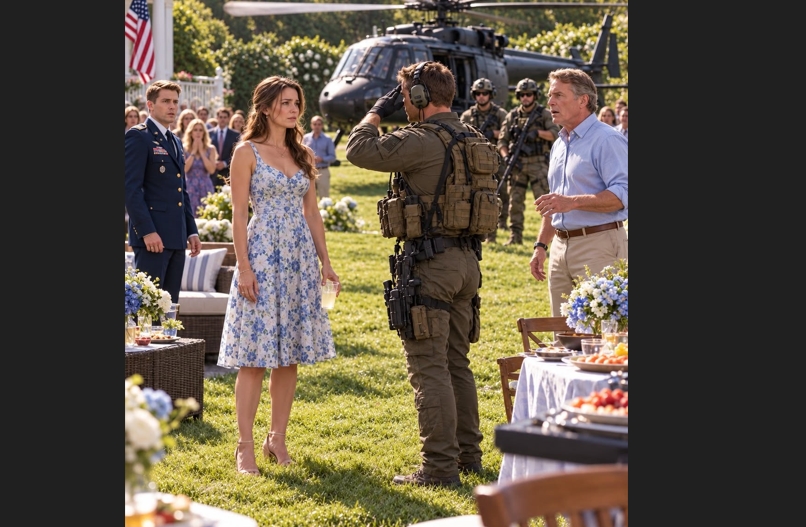
Vance’s hand reached his brow.
“Brigadier General Moody. We need you at command.”
My father’s mouth opened, but nothing came out.
Behind him, Brett slowly rose from behind the couch.
“General?” Dad finally whispered.
I acknowledged Vance. “Report.”
He stepped closer, lowering his voice.
“The outage is connected to a breach at the defense communications facility. Four civilian technicians are unaccounted for. Your deputy has the response underway. We lost the regular contact channels.”
The three-digit message had been the first warning. This was the confirmation.
I looked past him at the guests crouching beside overturned chairs.
“Get everyone inside before we lift off. Have the pilot hold.”
“Yes, ma’am.”
Dad reached toward me, then stopped.
“You’re a brigadier general?”
“Yes.”
“Why didn’t you tell me?”
For a moment, the helicopter seemed very far away.
“I invited you to my promotion six months ago. You said you weren’t wasting a Saturday watching me collect another office certificate.”
His eyes dropped.
He remembered.
Brett stepped forward. “I can come with you.”
“Help my mother get everyone inside. Once we’re gone, check whether the older neighbors need assistance.”
His face reddened, but he nodded.
Dad stood motionless beside the ruined buffet table.
“Aisha, wait. About what I said—”
“We’ll talk when I get back.”
Vance handed me a flight helmet. I gathered the skirt of my floral dress, climbed aboard, and fastened my harness.
Through the window, I watched my father help my mother up the porch steps.
Then the house disappeared beneath us.
At command, I changed into the spare uniform I kept in my office. A map filled the main screen. Reports came in from federal investigators, utility crews, and our personnel inside the facility.
Someone had used the power disruption to cover an intrusion. Four maintenance workers had been locked inside a service wing.
For hours, I coordinated with people who knew their jobs better than anyone else in the room knew them. I asked questions, checked conflicting reports, and refused to let urgency become guesswork.
At 2:17 in the morning, Vance brought me the final personnel count.
All four technicians were safe. The intruders were in federal custody. Utility crews were restoring the damaged network.
I read each technician’s name before signing the report.
Then I sat down and discovered that my hands were shaking.
Vance quietly set a cup of tea beside me.
“Your mother called the duty desk,” he said. “She only wanted to know whether you were safe.”
I borrowed an ordinary phone and called her back.
For once, when she asked how I was, I gave her an honest answer.
“Tired, Mom. Really tired.”
“Come home when you can,” she said. “I’ll keep something warm.”
I returned the following afternoon in my old Honda.
Dad was sitting alone at the kitchen table. In front of him lay my promotion invitation, retrieved from a stack of mail.
He stood when I entered.
“You don’t have to do that,” I said.
He sat again, awkwardly.
“I read it.”
“Six months late.”
“I know.”
For several seconds, he studied the lettering on the invitation.
“I thought I understood your career.”
“You decided what it was. Whenever I tried to tell you something different, you interrupted.”
He started to answer, then closed his mouth.
I pulled out the chair across from him.
“There’s something else. Something you need to understand before you ever comment on my having children again.”
His expression changed.
I kept the mission details to myself. I told him about being injured on an assignment, the hospital appointments, and the doctor who explained that I would never carry a pregnancy.
Dad lowered the invitation carefully onto the table.
“When?”
I told him.
He covered his mouth.
“That Christmas,” he said. “You barely spoke.”
“I was trying to get through dinner.”
He remembered what he had said that evening, too. Another joke about my career. Another question about grandchildren.
“I’m sorry, Aisha.” His voice broke. “I’m so sorry.”
I let the silence sit between us.
Then I said, “You would still owe me that apology if I worked at a reception desk.”
He nodded slowly.
“Yes. I would.”
“And the people who heard you humiliate me need to hear you correct it.”
He looked frightened then. Speaking to me alone was one thing. Admitting his behavior to the people whose admiration he enjoyed was another.
But he picked up his phone.
Over the next two days, he contacted every guest.
My aunt forwarded me the message he sent her.
“What I said about Aisha was cruel. I encouraged everyone to laugh at my daughter. Her accomplishments don’t excuse my behavior, and she should never have needed to prove anything to receive basic respect in my home.”
There was no mention of the helicopter.
No impressive title for him to borrow.
At our next family lunch, Brett apologized without trying to turn it into a joke.
“I wanted everyone to think I was important,” he admitted.
“Then take your responsibilities seriously,” I told him. “Start there.”
My relationship with Dad took longer.
For months, I kept our visits short. When he slipped into giving orders about my life, I stopped him. Gradually, he learned to ask questions and wait for the answers.
One evening, I arrived carrying groceries and found him clearing a place beside him at the kitchen table.
My mother was cooking. The television was off.
“How was your week, Aisha?” he asked.
“Mostly paperwork.”
He smiled gently.
“Tell me what you can.”
I sat down.
For the first time in years, I stayed until the coffee went cold.
“`