“Yes, Your Honor,” my father replied. “Twelve years. She chose the military over her family. We’ve carried that property ever since.”
Judge Simmons turned toward me. His gaze paused on my ribbons, then lifted to my face.
“Dear God… can that really be her?” he murmured.
My father’s smile faltered.
“Commander Evelyn Carter?”
“Retired, Your Honor.”
“I remember the coverage of your commendation. The evacuation convoy.”
I nodded once. Beside my father, my mother slowly lowered her eyes to the decorations she had been ashamed to look at.
The judge straightened the papers before him.
“Let’s examine the ownership records.”
I opened the folder on my table.
“My grandfather left the farmhouse to me. These are the recorded deed, the estate documents, and my property tax payments dating back to 2013.”
I handed over copies. My parents’ attorney began turning pages.
Dad leaned forward.
“Those bills were sent to our address.”
“Yes,” I said. “You forwarded them. I paid them.”
The attorney stopped at a bank statement.
“Mr. Carter, you told me these payments came from your account.”
“We handled everything.”
“That isn’t what I asked.”
For the first time, my father looked toward the courtroom doors.
I placed another statement on the table.
“I also sent money for repairs. The transfers are marked ‘roof,’ ‘porch,’ and ‘winter maintenance.’ This morning, I found the porch close to collapsing.”
“You should have come home and looked after it yourself,” Dad snapped. “You were perfectly capable of that.”
My fingers tightened around the edge of the table.
I had imagined answering him a hundred different ways. None of those imagined conversations had included the effort it took just to stand.
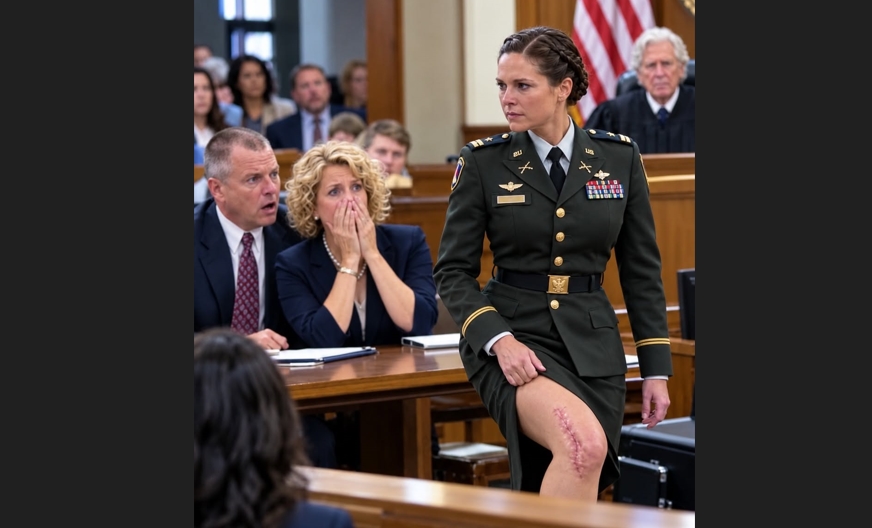
I rose carefully and lifted my skirt only enough to reveal the healed surgical scar above my reconstructed knee.
My mother covered her mouth.
“For fourteen months, I was learning how to walk again,” I said. “I paid the farmhouse taxes from a hospital room.”
Dad stared without speaking.
I lowered the fabric.
“Lewis didn’t come home from that convoy. I did. And some days, getting from my bed to the kitchen felt like the only thing I could manage.”
“Evelyn,” my mother whispered. “We didn’t know.”
“You told me you’d raised a daughter, not a soldier. After that, I didn’t know how to call you and ask for help.”
The clerk quietly moved a chair closer. I sat.
Judge Simmons gave me a moment, then returned to the documents.
“Counsel, what evidence supports your clients’ claim?”
Before the attorney could answer, my mother reached into her handbag.
“There’s something else.”
My father caught her wrist. She pulled away.
She unfolded a letter and placed it beside their attorney.
“Robert said we were protecting the property. I found this last night.”
It was an offer from a developer.
The farmhouse would be demolished. The land would become part of a new housing development.
Beneath the proposed price, my father had written two words:
Accept immediately.
I looked at him.
“You were going to sell Grandpa’s house?”
“It’s valuable land, Evelyn. Be practical.”
“You told the court you wanted to preserve it.”
He glanced at his attorney.
No one supplied an answer for him.
The judge ordered further records to be produced and scheduled another hearing. My parents’ accusations would have to survive bank statements, receipts, and the paperwork Grandpa had signed years before.
They didn’t.
Six weeks later, with a lawyer beside me, I heard the court reject their claim. My ownership remained intact. A separate written agreement required my parents to return the maintenance money they could not account for.
There was no applause. I sat still, holding the order, until my lawyer gently said my name.
It was over.
Outside, my father approached me.
“You could have settled this privately.”
“You sent me a summons, Dad.”
He opened his mouth, then closed it.
My mother waited until he walked away.
“I knew your grandfather wanted you to have that house,” she said. “And I let your father convince me we deserved it more.”
Her voice broke.
“I’m sorry. For this. For what I said about your uniform. For making it so hard for you to come home.”
I had wanted those words for twelve years. Hearing them didn’t give those years back.
“I can’t promise everything will be all right between us,” I said.
She nodded.
“But if we talk again, we start with the truth.”
That spring, I hired a contractor to rebuild Grandpa’s porch. A local veterans’ group helped me plan a quieter future for the farmhouse: a few temporary rooms for service members finding their feet after leaving the hospital.
We widened the bathroom doorway, installed a ramp, and painted the kitchen the yellow Grandpa had always liked.
I called it Lewis House.
My mother came on Saturdays to help with the garden. Sometimes we talked. Sometimes we worked in silence. She learned to accept both.
My father declined the opening invitation. I left his name on the envelope and put it away.
Our first guest arrived carrying one duffel bag. He hesitated at the bottom of the ramp while Knox watched through the screen door.
“I just need somewhere to start over,” he said.
I understood the effort those words had cost him.
“Your room’s ready.”
On the mantel, beside Lewis’s photograph, stood a picture of Grandpa holding his old hammer.
That evening, I paused beside it. From the kitchen came the clatter of plates, Knox’s impatient footsteps, and someone laughing.
The farmhouse had survived.
And finally, it sounded like home again.