At first, Dad looked toward the ceiling.
“What on earth is that?”
The wine trembled in my glass. Beyond the patio doors, the trees bent beneath a sudden rush of wind.
Then the helicopter appeared.
A Black Hawk descended toward the open lawn beyond the garden. A man in a dark jacket waved approaching guests back beneath the terrace roof as the aircraft settled.
My phone vibrated.
TRANSPORT ON SITE.
I set my untouched wine on a passing waiter’s tray.
An hour earlier, my office had warned me that I might be recalled. I had confirmed my location and quietly informed the venue manager. A deteriorating situation overseas required an urgent briefing.
I had hoped to stay until the cake was cut.
Now, beneath the thunder of the rotors, my father’s arm slipped from my shoulders.
“Amelia,” he said. “What’s going on?”
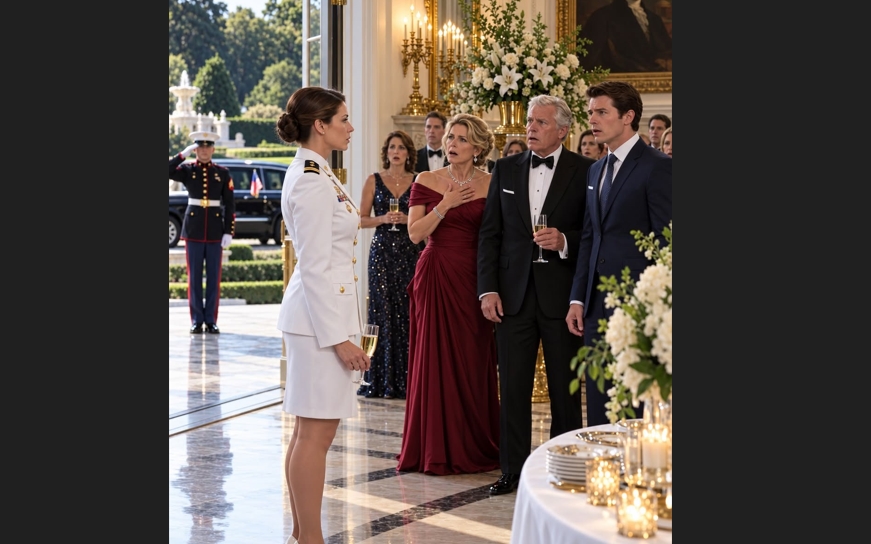
Before I could answer, a Marine approached the terrace. He stopped in front of me and saluted.
“Admiral Hayes, the President is waiting.”
Nobody laughed.
Aunt Ruth’s hand froze against her pearls. Grant lowered his glass. My mother stared at me with her lips parted.
Dad looked behind me, as though the Marine must have meant someone else.
“Admiral?” he repeated.
“Yes, Dad.”
The Marine waited a few steps away while I collected my handbag.
“Since when?” Dad asked.
“Since the promotion ceremony you were invited to last spring.”
He frowned. “You said there was some Navy event.”
“I said I was being promoted. I asked you to come.”
His gaze moved toward the guests, searching for a friendly expression. Nobody offered him one.
“Well, how was I supposed to understand what that meant?”
My mother spoke before I could.
“It was printed on the invitation, Leonard.”
Dad turned toward her.
For twenty-two years, she had softened his remarks, changed subjects, and asked me to understand him.
This time, she held his gaze.
“I put it beside your breakfast. You told me we couldn’t close the office for another one of Amelia’s ceremonies.”
The rotors continued turning beyond the terrace.
Dad swallowed.
“You should have insisted.”
I looked at the familiar face I had spent so much of my life trying to please.
“I asked you as your daughter. That should have been enough.”
He glanced at the Marine again.
“And now the President wants to see you?”
“There’s work to do.”
For once, he had no joke ready.
I started toward the lawn.
“Amelia, wait.”
He followed me to the terrace steps. His voice dropped.
“I didn’t know.”
I stopped.
“Would it have been all right to speak to me that way if I were still the young sailor who left home?”
He opened his mouth.
Then closed it.
“I have to go, Dad.”
He stepped aside.
As the helicopter lifted, I saw him beneath the anniversary banner, one hand hanging uselessly at his side.
I had imagined his astonishment before. During lonely holidays and long watches, I had pictured a moment when he would finally understand.
In those imaginings, it had felt wonderful.
Now I mostly wished he had come to the ceremony.
At the command center, I changed into the uniform kept ready in my office and joined the briefing. Families overseas needed a safe route home. Ships, aircraft, and diplomatic teams needed a coordinated plan.
For the next several hours, nobody asked whether I had found a husband.
They asked what resources were available, what could go wrong, and how soon we could move.
I answered.
By Sunday evening, the first evacuees were arriving safely.
When I finally checked my personal phone, there were seventeen missed calls.
Grant had left a message.
“I’m sorry I laughed. I knew it was cruel before the helicopter came. I should have said something.”
I listened to that one twice.
My mother’s message was shorter.
“I’ve been asking you to keep the peace for years. I understand now who was paying for it.”
Dad had sent a photograph.
It showed a television screen carrying a brief report about the evacuation. My name appeared beneath an image taken at the briefing.
Underneath, he had written: That’s my daughter.
I stared at those three words for a long time.
Then I replied.
“I was your daughter yesterday, too.”
He did not answer that night.
Three days later, he called.
I nearly let it ring.
“Amelia?”
“Yes.”
“I’ve been trying to figure out what to say.”
I waited.
“I could tell you I was joking. Or that I didn’t understand your job.” His breath caught. “But I understood that you were hurt. I kept going because people were laughing.”
I sat down.
I had heard my father apologize for late deliveries and accounting errors. I had never heard him describe his own cruelty so plainly.
“I wanted you in the company,” he continued. “When you chose something else, I treated it like you’d rejected me.”
“I chose a career, Dad.”
“I know.”
“And you made every visit home feel like I had to defend it.”
“I know that now, too.”
He asked if we could have dinner.
“Eventually,” I said. “But I need more than a different introduction at your next party. I need you to stop making me the joke.”
“All right.”
“And if it happens again, I’ll leave.”
He was quiet for a moment.
“I understand.”
I didn’t forgive him during that call. We agreed to speak again the following week.
He called when he said he would.
The week after that, he called again.
Sometimes he stumbled. Once, he started explaining why I had misunderstood him, then stopped himself.
“No,” he said. “That’s what I always do. Go on.”
So I did.
Grant and I began talking, too. He told me about the pressure of being the son expected to inherit everything. I told him how lonely it had been to stand beside them and feel invisible.
Neither conversation fixed the other. Both helped.
Two months later, I accepted an invitation to Sunday dinner.
There were no guests, no photographers, and no anniversary banner.
On the hallway wall, beside Grant’s graduation portrait, hung the photograph from my promotion ceremony.
My parents were absent from it.
Dad noticed me looking.
“I should have been there,” he said.
“Yes.”
He nodded without offering an excuse.
At dinner, he asked about my first ship.
I gave him the short answer I had learned to offer at home.
Then he asked another question.
And another.
When my mother began clearing the plates, he stayed at the table.
“You mentioned someone who helped you when you first enlisted,” he said. “What was her name?”
I looked at him.
He had remembered something I’d told him on the telephone the week before.
It was such a small thing.
I felt my eyes fill anyway.
“Chief Morgan,” I said. “She taught me how to stand a proper watch.”
“Tell me about her.”
This time, I did.
The coffee grew cold. Grant brought out the cake. My mother sat down again.
And my father listened until I finished.
THE END.