My husband pushed open the door first.
Then he stopped so abruptly that I nearly walked into him.
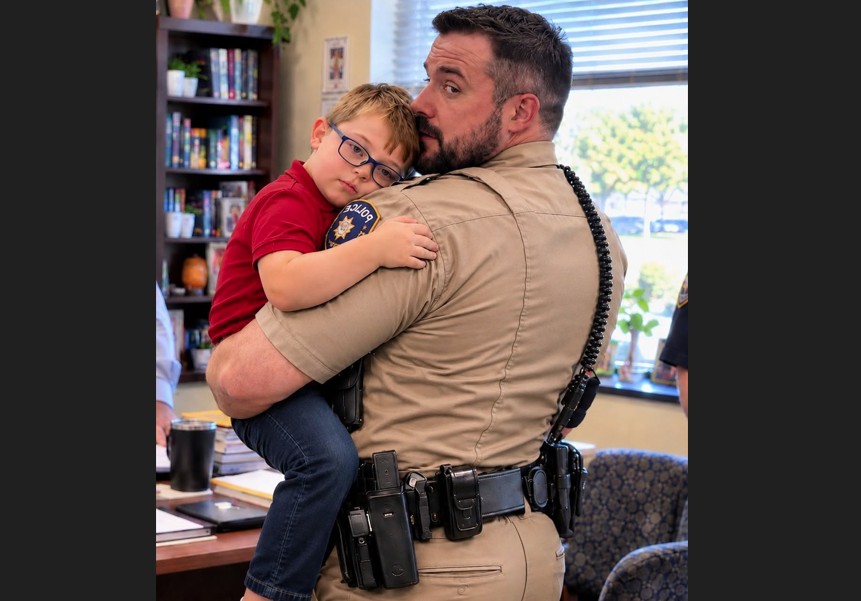
A police officer stood beside the principal’s desk, holding Ethan against his chest. Our son’s glasses had slipped down his nose. His fingers were curled tightly around the officer’s shoulder.
“Ethan?”
He lifted his head.
“Mom. I didn’t leave him.”
I crossed the room and reached for him. The officer gently lowered him into my arms.
“Who, sweetheart? What happened?”
“Oliver.”
Across the desk, Principal Harris stood up.
“Mrs. Parker, before we—”
“Is my son hurt?”
“No,” the second officer said immediately. She pulled a chair toward me. “He’s safe. He isn’t in trouble.”
My knees weakened.
“Then why are you here?”
The man who had been holding Ethan rubbed a hand across his face. His name badge read BENNETT.
“Oliver is my son.”
He paused, struggling to steady his voice.
“And your boy helped us find him.”
***
For nearly half an hour that morning, nobody had known where Oliver was.
He hadn’t returned to class after recess. His jacket was still on his hook. His backpack sat beneath his desk.
Staff checked the playground, the bathrooms, and the nurse’s office. When they couldn’t find him, the school called the police and his parents.
Officer Bennett had been on duty nearby.
“I heard the school’s name over the radio,” he said. “Then I heard my son’s description.”
He looked down at his hands.
Ethan leaned against me.
“He wasn’t outside, Mom.”
The second officer, Ruiz, nodded.
“No. He was in a storage room behind the auditorium.”
The room was used for old scenery and broken music stands. Its door stood in a narrow backstage passage, out of sight from the main hall.
Someone had blocked it from the outside.
I looked at Principal Harris.
“Someone?”
“We’re still gathering statements,” Officer Ruiz said. “But Oliver has told us two older students took his backpack at recess. They told him he could get it back in the auditorium.”
They had pushed the bag into the storage room.
When Oliver went inside, they shut him in.
Then they carried his backpack back to his classroom.
For a moment, all I could hear was the clock above the filing cabinet.
“Where is he now?” my husband asked.
“With his mother and the nurse,” Officer Bennett said. “He’s frightened. But he’s safe.”
Ethan’s shoulders loosened a little.
“I said they would get the door open.”
***
Ethan had been walking past the auditorium on his way back from the bathroom when he heard someone knocking.
At first, he thought it was part of a music lesson.
Then he heard his name.
“Oliver knew my shoes,” Ethan told me. “He could see them underneath.”
I pictured my son’s bright blue sneakers on the other side of that door.
Oliver had called to him.
Ethan tried the handle. When it wouldn’t open, he went to find an adult.
“I told the lady in the hall.”
Principal Harris lowered his eyes.
“The substitute supervising that corridor brought him here.”
“And?”
“She said Ethan was upset and talking about someone being trapped. We were already searching for Oliver. I asked Ethan where he’d seen him.”
“Behind the wall,” Ethan said.
There was a long silence.
“The entrance is behind a painted scenery panel,” Harris explained. “I thought he meant the mural near the playground. I sent someone to check there.”
“Did you ask him to show you?” my husband said.
Harris didn’t answer immediately.
Ethan rubbed at a mark on his jeans.
“I tried to go. He told me to sit.”
My husband turned away, pressing his fingers against his mouth.
Officer Ruiz leaned forward.
“When I arrived, Ethan kept pointing toward the hallway. So I asked him to take me there.”
That was all.
One question.
One adult willing to follow him.
“He took me straight to the auditorium,” she said. “We could hear Oliver when we got backstage.”
Officer Bennett swallowed.
“When we opened the door, Oliver wouldn’t come out at first. Ethan sat on the floor and talked to him.”
“What did you say?” I whispered.
Ethan looked puzzled that I needed to ask.
“That I was still there.”
***
A quiet knock interrupted us.
The door opened, and a woman stood in the doorway with a pale, dark-haired boy tucked beneath her arm.
Oliver.
His eyes moved around the room until they found Ethan.
“You came back,” he said.
Ethan slid from my lap.
“I said I would.”
Oliver crossed the office and hugged him so suddenly that both boys stumbled.
His mother covered her mouth.
Officer Bennett moved beside her, putting one arm around her shoulders and the other around his son.
For several seconds, nobody spoke.
Then Oliver looked up at me.
“He didn’t tell them.”
My stomach tightened.
“Tell them what?”
Oliver glanced at Ethan.
Our son looked down.
“Sweetheart,” I said carefully. “Is there something else?”
Oliver’s mother knelt beside him.
“You can tell us.”
The words came slowly.
The older boys had been bothering Oliver before Ethan ever arrived. Taking things. Blocking his way. Making him repeat words when his stutter caught.
He had tried avoiding them.
Then, on Tuesday, they had seen him sitting beside Ethan.
“They said if I kept being his friend, they’d start on him too.”
I felt Ethan’s small hand slip into mine.
“Oliver told me Wednesday,” he said. “He said don’t tell anybody.”
“And what did you say?”
“I said I wouldn’t tell the boys where we eat.”
Oliver shook his head.
“I thought you’d stop sitting with me.”
Ethan frowned.
“But you saved my chair.”
Such a small thing.
On Tuesday, Oliver had placed his lunchbox on the seat beside him and waved Ethan over.
I had spent that evening feeling grateful that someone had welcomed my son.
I had never imagined how badly that other little boy needed someone to stay.
***
Principal Harris came around his desk.
“I owe both of your families an apology.”
My husband faced him.
“You owe the boys more than that.”
“Yes,” Harris said. “I do.”
He crouched a few feet from Ethan.
“You were trying to help Oliver, and I didn’t listen carefully enough. I’m sorry.”
Ethan studied him.
“Next time, can I show you?”
Harris’s expression changed.
“Yes. Next time, you can show me.”
Then I asked the question that had been burning in my chest since we arrived.
“Why did you call us like that? Why didn’t you tell me he was safe?”
Harris stood.
“I was shaken by what had happened. I handled the call badly.”
“And telling us not to speak to other parents?”
“Families had seen the police arrive. I wanted you to hear the facts here first.” He paused. “But I made it sound as though Ethan had done something wrong. There’s no excuse for that.”
I looked at the chair where my son had been told to wait.
“For years, I worried that he wouldn’t be able to explain what he needed at school,” I said. “Today he explained it. Someone needed to listen.”
Harris nodded without trying to defend himself.
***
We took Ethan home early.
Before we left, Officer Bennett crouched beside him.
“Would you like me to come back next week and thank you in front of your class?”
Ethan considered it.
“Would I have to stand at the front?”
“Only if you wanted to.”
“No, thank you.”
The officer smiled gently.
“All right.”
“Can Oliver come to our house instead?”
His mother let out a small, shaky laugh.
“I think he’d like that very much.”
“Friday is pizza,” Ethan added.
For the first time since the phone rang, I laughed too.
***
We didn’t send Ethan back on Monday with nothing more than a promise.
Both families met with the school. We asked for a written account of what had happened and a clear plan for keeping the boys safe.
The students involved were removed from classes while the incident was investigated. The school contacted their families, increased supervision around the auditorium, and arranged regular check-ins with Ethan and Oliver.
The apologies mattered. What happened afterward mattered more.
Ethan still had difficult mornings.
Sometimes he needed extra time with his work. Sometimes another child didn’t understand him. Once, he and Oliver stopped speaking for an entire lunch period because they disagreed about whose turn it was to choose a game.
They made up before dismissal.
Little by little, I stopped asking him whether everyone had been nice.
I started asking what he had done.
Usually, he had plenty to tell me.
***
Three weeks after that terrible Friday, Oliver came over for pizza.
The boys built something enormous out of cushions, argued over whether it was a spaceship or a submarine, and finally decided it could be both.
When Oliver’s father arrived to collect him, we found them on the living-room floor, making a list.
“What’s that?” I asked.
“My birthday,” Ethan said.
It was still two months away.
He handed me the paper.
There were names from his class, crookedly written in pencil. Beside some, he had drawn little pictures to help him remember what they liked.
Oliver had a dinosaur.
At the bottom, Ethan had added one instruction:
*Enough chairs for everybody.*
I ran my thumb along the edge of the page.
For years, I had wondered whether there would ever be classmates at his birthday table. Now he was worried about where they would all sit.
“We can find more chairs,” I said.
Oliver pointed at the space beside Ethan’s name.
“I’m sitting there.”
Ethan took back the pencil.
“I know.”
And beside Oliver’s name, he drew a little chair.
**THE END**