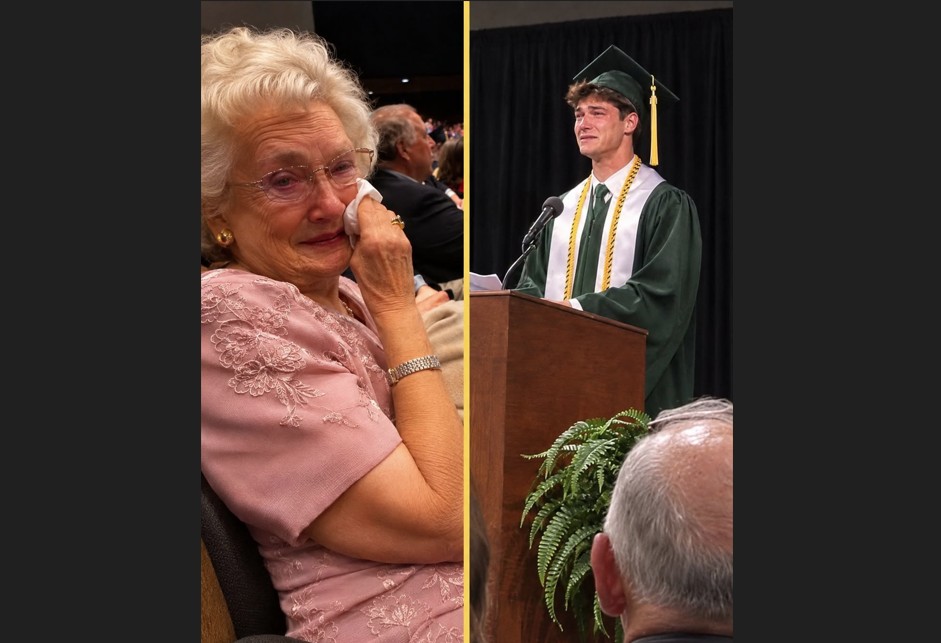
Kevin stopped in front of my seat.
For a moment, neither of us spoke. He looked down at the flowers trembling in my hands, then at the empty chair beside me.
“I promised you the front row,” he whispered.
“I could see you from here.”
His face crumpled.
He switched off the wireless microphone and knelt in the aisle.
The envelope lay between us. Yellowed paper. A crease across one corner. My sister Ruth’s old address written in my handwriting.
No stamp.
There had never been a stamp.
“Where did you find that?” I asked.
“When I was home in March. You asked me to get your winter blankets down. The box underneath them fell open.”
I remembered him carrying the blankets into the kitchen. He had been quiet at supper, but he’d said he was tired.
Inside that envelope was a letter I had written four days after we buried his parents.
Four days after I had stood beside my daughter’s grave and wondered how I was supposed to walk away from it.
Kevin unfolded the paper.
He didn’t need to read it aloud.
I knew the words.
*Ruth, I don’t think I can raise him. Please come and take him. He cries for his mother, and I have nothing left to give. I want my life back.*
For twenty years, those sentences had stayed inside a box.
Now they were in the hands of the little boy I had written them about.
“I thought…” Kevin swallowed. “I thought you’d spent your whole life wishing someone had taken me away.”
“Oh, sweetheart.”
“All those shifts. The things you couldn’t buy. Every time you said you were tired.”
He pressed the heel of his hand against his eyes.
“I started remembering everything differently.”
I looked at the letter. The ink had blurred beneath an old water stain.
“You should have asked me.”
“I know.”
“You let me sit at home wondering what I had done.”
His head dropped.
“I know that, too.”
Around us, the auditorium waited. Someone several rows ahead quietly passed back a packet of tissues.
Kevin took it and handed it to me.
“Last night, I called Aunt Ruth.”
I closed my eyes.
“She told me what happened after you wrote it.”
For the first time that morning, I let myself breathe.
***
At fifty-eight, I had believed I understood grief.
I had buried my husband. I had learned to cook one portion, sleep on one side of the bed, and fix the loose kitchen handle myself.
Then my daughter and her husband died, and someone brought me a little boy wearing shoes that lit up when he walked.
Kevin kept asking when his mother would pick him up.
At night, he woke screaming for her.
I would hold him until he slept, then sit upright because I was afraid moving might wake him again.
By the fourth night, I had hardly eaten. I had forgotten a kettle on the stove. I had stood in the grocery store unable to remember what I had gone there to buy.
That was the night I wrote to Ruth.
Not a careful letter.
Not a fair one.
Just the worst thoughts of a woman who was frightened, exhausted, and missing her daughter so badly she could barely stand.
I put it in an envelope.
Then I heard Kevin calling from the bedroom.
He was sitting in the middle of the mattress, clutching one of his mother’s cardigans.
“Are you going away, too?”
I sat beside him.
“No.”
He reached for my sleeve.
“Can you stay till morning?”
So I stayed.
The next morning, I called my sister.
I didn’t ask her to take him.
I asked her to come.
***
“She said she found you asleep sitting against my bedroom door,” Kevin whispered.
I nodded.
“Ruth stayed a week.”
“She told me she offered to let me live with her for a while.”
“She did.”
“And you said you needed some sleep and help with the shopping. That you wanted me home.”
My lips trembled.
“I did want you home.”
“Why did you keep the letter?”
For years, I had asked myself that same question.
“At first, I was ashamed of it. I put it away because I couldn’t bear to read it again.”
I touched the worn edge.
“Later, I found it while cleaning. By then, we were doing all right. You were in school. You’d started bringing home those spelling certificates.”
A small, broken smile crossed his face.
“You put every one on the fridge.”
“Even the one you spilled orange juice on.”
I looked down at the envelope.
“I nearly threw it out. But I remembered how certain I had been that I couldn’t manage another day. I suppose I kept it because I had.”
Kevin bent forward until his forehead rested against my hands.
“I read one page,” he said. “And I stopped believing twenty years.”
I stroked his hair.
The graduation cap slipped sideways, just as his little winter hats always had.
Then he looked up.
“I need to finish what I started up there. But I won’t read your letter. I shouldn’t have made you afraid in front of all these people.”
He waited.
“Would it be all right if I told them I was wrong?”
I studied his face.
“Yes,” I said. “You may tell them that.”
***
He stood and offered me his arm.
My knees weren’t steady, but I took it.
An usher led us down the aisle to an empty seat near the front. Kevin placed my grocery-store flowers in my lap before returning to the stage.
He stood behind the microphone for several seconds.
“I had a speech prepared about hard work,” he began. “About everything it took to get here.”
He glanced down at the paper waiting on the lectern.
“But I need to apologize first.”
The room was still.
“I found a private letter my grandmother wrote just after my parents died. She was grieving. She was overwhelmed. She was afraid she couldn’t raise me.”
His voice shook.
“I decided that meant she hadn’t wanted me. And instead of asking her about it, I hurt her.”
I pressed the tissue beneath my glasses.
“She called. I wouldn’t answer. She sent cookies, and I sent them back.”
He paused, struggling to continue.
“There isn’t a good excuse for that.”
A woman beside me reached over and gently squeezed my wrist.
“My grandmother worked two jobs. She came to school plays in her work uniform. Once, she fell asleep helping me study, with the answer sheet still in her hand.”
A few people laughed softly.
“I used to think she wasn’t afraid of anything.”
He looked directly at me.
“Now I know she was afraid. She stayed anyway. She asked for help, and she raised me.”
His hands tightened around the edge of the lectern.
“Grandma, you don’t owe me forgiveness because I’m standing in front of a microphone. I’ll come home. I’ll answer your questions. And when you call me, I’ll pick up.”
That was when I began crying so hard I couldn’t see him clearly.
Not because everything was suddenly fixed.
Because, at last, he understood what needed fixing.
When the applause began, Kevin waited quietly. Then he thanked his teachers, congratulated his classmates, and finished his speech.
Later, when they called his name, he walked across the stage to receive his diploma.
He searched the front row.
I lifted his flowers.
This time, he knew exactly where to look.
***
Outside, families crowded together for photographs.
Kevin handed his diploma to a friend and came straight to me.
“Can we get a picture?”
“In a minute.”
He stopped.
There were things I had spent a month rehearsing to an empty kitchen.
Now that he was in front of me, I needed to say them.
“That telephone call hurt me, Kevin.”
“I know.”
“No. Let me finish.”
He nodded.
“I can understand you being angry. I can understand finding something like that and not knowing what to think. But you cannot decide what I meant without letting me speak.”
Tears filled his eyes again.
“You’re right.”
“I won’t always have the right words. I didn’t have them in that letter. But you must give me the chance to find them.”
“I will.”
“And if you need time, say you need time. Don’t tell me to leave you alone and make me wonder whether I’ve lost you.”
He reached for my hand slowly, giving me time to pull away.
I didn’t.
“I’m so sorry, Grandma.”
“I believe you.”
Then I straightened his crooked cap.
“Now get your diploma. I didn’t come all this way for a photograph of you empty-handed.”
He laughed through his tears.
In the picture, my eyes were swollen, his collar was uneven, and one of the flowers had snapped in half.
I ordered two copies.
***
That evening, we went home.
Kevin carried my overnight bag inside, then stood in the kitchen looking at the table.
“Is this where you were sitting when I called?”
“Yes.”
He pulled out a chair.
“Can we sit for a while?”
We stayed there until the windows turned dark.
He asked about those first weeks after the accident. This time, I told him the difficult parts as well as the sweet ones.
I told him about Ruth bringing groceries. About our neighbor walking him to nursery school so I could get to work. About crying in the laundry room and then coming out to discover he had tried to make me toast.
He listened.
Then he asked me something he hadn’t asked since he was small.
“What was Mom like when she was my age?”
I went upstairs and brought down a different box.
Photographs. Birthday cards. A terrible poem she had written at sixteen.
We laughed over that poem until we both had to wipe our eyes.
Before bed, Kevin placed the old letter on the table.
“Do you want me to throw it away?”
I thought for a moment.
Then I shook my head.
“Put it back.”
He slipped it into its envelope.
Beside it, I placed the photograph his friend had printed for us that afternoon at a pharmacy.
Two days from the same life.
Neither one needed to be hidden.
***
Things became better in small ways.
Kevin called when he said he would. When work kept him late, he sent a message. I stopped saying “everything’s fine” on days when it wasn’t.
A few weeks later, I told him I was still afraid whenever the phone rang unanswered.
He didn’t tell me to forget it.
He listened.
By autumn, his graduation photograph hung above the kitchen table.
And on the first cold Sunday of the season, he came over carrying groceries and a packet of oatmeal cookies.
“Store-bought?” I asked.
“I’m hoping you’ll teach me.”
“They’re going to need all the help they can get.”
After dinner, I washed the dishes while he dried them. Then I went to turn off the kitchen light.
From the living room, I heard him call my name.
He was sitting on the couch, holding up one end of the old blanket.
“Come sit down.”
I settled beside him. He tucked the blanket over my knees and moved closer.
“Grandma,” he whispered, “I saved you the warm spot.”
This time, I let him take care of me.
**THE END**
:chatgpt-content-reference{index=”0″}[Part_2_The_Letter_I_Never_Sent.md](sandbox:/workspace/scratch/99afcd678b63/Part_2_The_Letter_I_Never_Sent.md)