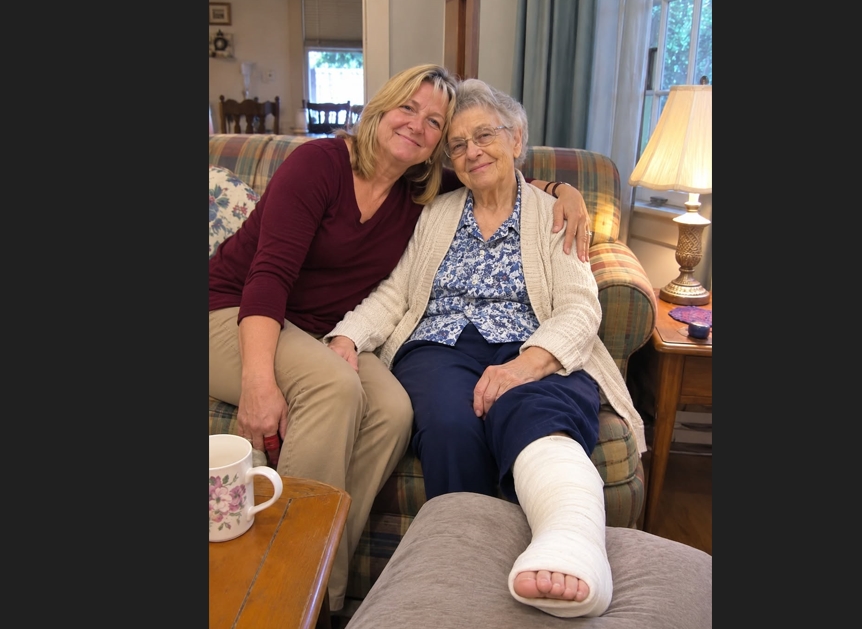
I stared at Patricia, trying to understand what she’d just told me.
“What do you mean Elora planned everything?”
Patricia didn’t answer immediately. Instead, she placed the shoebox on my kitchen table.
“Before you open this,” she said quietly, “you need to understand something. Elora really did break her leg. She really did need help. But that wasn’t the only reason she chose your house.”
My stomach tightened.
“Then why did she come?”
Patricia lowered her eyes.
“Because of me.”
I blinked.
“You?”
She nodded and gently lifted the lid.
Inside were several yellowed envelopes, an old photograph, a tiny knitted baby sweater, and a hospital bracelet so faded that I could barely make out the writing.
Patricia handed me the photograph.
It showed a young woman holding a newborn baby.
I recognized her immediately.
“That’s Elora.”
“Yes,” Patricia whispered.
“Whose baby is that?”
Patricia’s eyes filled with tears.
“Me.”
For a moment, I couldn’t speak.
“What?”
“Elora is my biological mother.”
I stared at her.
I’d lived next door to Patricia for almost eight years. She was a quiet, thoughtful woman in her fifties who occasionally brought me homemade bread and watered my plants when I traveled.
Not once had she mentioned being related to Elora.
“But Elora has three children,” I said.
Patricia gave a sad smile.
“She has four.”
Then she told me a story that changed everything I thought I knew about my former mother-in-law.
Fifty-four years earlier, when Elora was just seventeen, she’d become pregnant.
Her parents were deeply ashamed. They sent her to stay with relatives in another town until the baby was born.
After the delivery, Elora was pressured into signing adoption papers.
She’d held her daughter for less than an hour.
“She named me Grace,” Patricia whispered. “But my adoptive parents changed my name.”
I looked down at the photograph again.
There was something devastating about Elora’s expression.
She wasn’t smiling.
She was staring at the baby as though memorizing every detail.
“She spent decades wondering what happened to me,” Patricia continued. “And I spent most of my life wondering why my mother didn’t want me.”
I felt tears gathering.
“How did you find each other?”
“Six months ago, I finally received information from the adoption agency that helped me trace her.”
Patricia explained that she’d contacted Elora privately.
They’d exchanged letters and spoken on the telephone.
Eventually, Patricia told Elora where she lived.
And that was when something extraordinary happened.
Elora recognized my street.
She knew I lived next door.
“She told me about you,” Patricia said. “She said you were the daughter she wished she’d had the courage to protect when your marriage fell apart.”
I swallowed hard.
“Then why didn’t either of you tell me?”
“Because I wasn’t ready,” Patricia admitted. “Finding her was one thing. Letting her into my life was another.”
She paused.
“And Elora was afraid of losing me again.”
I sat down heavily.
“So the broken leg…”
“Was real. But even before her accident, she’d been thinking about spending time near me. When her children refused to help her, she realized staying with you would give us a chance to know each other.”
Suddenly, everything made sense.
The questions about my work schedule.
The nervousness when I came home early.
The afternoons when Elora seemed unusually happy for no apparent reason.
“She was meeting you while I was gone?”
Patricia nodded.
“Sometimes I’d come over. We’d sit in the spare bedroom and talk for hours. Other times, she’d tell me stories about her childhood.”
“Why hide it?”
“Because we were both frightened that something so precious might disappear if we rushed it.”
I picked up one of the envelopes.
The handwriting was unmistakably Elora’s.
On the front, it said:
To my little Grace, on your fifth birthday.
I opened it carefully.
Inside was a letter.
My darling girl,
Today you are five years old. I wonder whether you like flowers or whether you prefer climbing trees. I wonder if somebody reads you bedtime stories and kisses your forehead when you’re frightened.
I hope you are loved.
I hope you never believe I stopped loving you.
I hope someday I can tell you that myself.
I couldn’t finish reading.
There were dozens of letters.
One for her tenth birthday.
Another for her eighteenth.
One written the year she turned thirty.
For decades, Elora had written to a daughter she believed she’d never see again.
“She kept every letter?” I whispered.
Patricia nodded.
“She brought them to me during those four weeks. She said she’d carried them through three house moves and an entire lifetime.”
Then Patricia reached into the bottom of the box and removed one final envelope.
This one was addressed to me.
My hands trembled as I opened it.
My dearest girl,
I owe you an apology.
When I asked to stay with you, I didn’t tell you everything. I truly needed help, but I also wanted to be near the daughter I’d spent fifty-four years missing.
I was afraid that if I told you, you might feel used.
Please believe me when I say your kindness meant more than you can imagine.
My three children had every opportunity to help me. You owed me nothing, especially after what Shane did to you.
Yet you opened your door without hesitation.
You never made me feel like a burden.
You reminded me that family isn’t simply something we’re born into. Sometimes it’s something we create through kindness.
And there is one more thing I haven’t had the courage to tell you.
I’m not going back to my old house.
I stopped reading.
“What?”
Patricia looked toward her front door through the kitchen window.
“Elora is staying with me now.”
I stared at her.
“She’s next door?”
“Yes.”
“Why didn’t she tell me herself?”
“Because she thought you’d be angry.”
I stood up so quickly that my chair scraped against the floor.
“Patricia, I’ve just spent four weeks helping that woman get dressed, making sure she takes her medication, and arguing with her about whether she should be walking without her crutches.”
Patricia looked worried.
Then I grabbed my coat.
“And she thinks I’m going to be angry because she found her daughter?”
Patricia’s face crumpled.
I shook my head.
“Take me to her.”
We walked next door.
When Patricia opened the door, I found Elora sitting in a comfortable chair beside the window, her injured leg resting on a pillow.
The moment she saw me, her expression changed.
“Oh, sweetheart.”
Her voice trembled.
“I suppose you know.”
I crossed my arms.
“I do.”
She looked down.
“I’m sorry. I should have told you.”
“Yes,” I replied. “You should have.”
Tears slipped down her cheeks.
“I never meant to deceive you. I was just so afraid.”
“Afraid of what?”
“That you’d think I only came because you were useful to me.”
I walked toward her.
“Elora, look at me.”
She raised her head.
“You were my family long before you broke your leg. You didn’t have to invent a reason to stay close to me.”
Her lips trembled.
Then I hugged her.
She clung to me and began crying.
For several minutes, neither of us spoke.
When we finally pulled apart, Patricia was standing in the doorway, wiping her own eyes.
But the story wasn’t over.
Two days later, Shane called me.
I hadn’t spoken to him in five years.
His voice was sharp.
“What have you been telling my mother?”
I closed my eyes.
“Hello to you too, Shane.”
“She says she has another daughter. Now she’s staying with some stranger instead of coming home. What exactly have you done?”
I felt my patience disappear.
“Your mother called you when she broke her leg. Do you remember?”
Silence.
“She needed help,” I continued. “You told her you were too busy.”
“That’s none of your business.”
“She made it my business when I became the person who cared for her.”
He started protesting, but I interrupted.
“Patricia isn’t a stranger. She’s your sister. And if you have questions about your mother’s past, you need to speak to your mother respectfully.”
Then I ended the call.
That weekend, Elora gathered all four of her children together for the first time.
I didn’t attend.
It wasn’t my story to tell.
Later, Patricia said the conversation had been difficult.
There were tears, accusations, confusion, and questions Elora couldn’t answer without reopening old wounds.
Shane was especially upset.
But Elora refused to apologize for having another daughter.
“I’m sorry I kept this secret,” she told them. “But I will not apologize for loving my child.”
Nobody had an answer to that.
Over the following months, the family slowly began adjusting.
Not every relationship healed.
Not every apology came easily.
But something beautiful happened between Elora and Patricia.
They began making up for lost time.
They went through old photographs, cooked family recipes, and spent Sunday afternoons together.
And every Sunday evening, I joined them for dinner.
One evening, several months later, I arrived to find Elora sitting at the kitchen table with Patricia.
Between them was the old shoebox.
Elora smiled when she saw me.
“We were just talking about you.”
“Should I be worried?” I joked.
Patricia laughed.
“No. Mom was telling me about the first time you invited her for Christmas dinner after your divorce.”
I sat beside them.
Elora reached for my hand.
“You know,” she said softly, “for years I thought the worst thing that ever happened to me was losing my first daughter.”
She looked at Patricia.
“Then I thought the worst thing was watching my son destroy his marriage to a wonderful woman.”
Her fingers tightened around mine.
“But now I understand something.”
“What?” I asked.
She smiled through her tears.
“Sometimes life gives us a second chance to love people properly.”
Patricia leaned against her shoulder.
I looked at the two women, at the little shoebox filled with decades of unanswered love, and at the extra chair they’d pulled up for me.
Five years earlier, my divorce had made me believe I’d lost an entire family.
Now, sitting in my neighbor’s kitchen, I realized something extraordinary.
I hadn’t lost Elora when I divorced her son.
And in helping her recover from a broken leg, I’d unknowingly helped reunite a mother and daughter separated for more than half a century.
But perhaps the most beautiful part came the following Christmas.
Elora handed me a small wrapped package.
Inside was a framed photograph of the three of us, sitting together on Patricia’s porch.
On the back, she’d written seven words:
“My two daughters, and my second chance.”
That was when I finally cried.
Not because I felt betrayed.
Not because of the secret she’d kept.
But because I understood that a marriage could end without love disappearing from every relationship it had created.
And the woman I’d once called my mother-in-law had given me something I never expected to find again.
A family.
THE END.