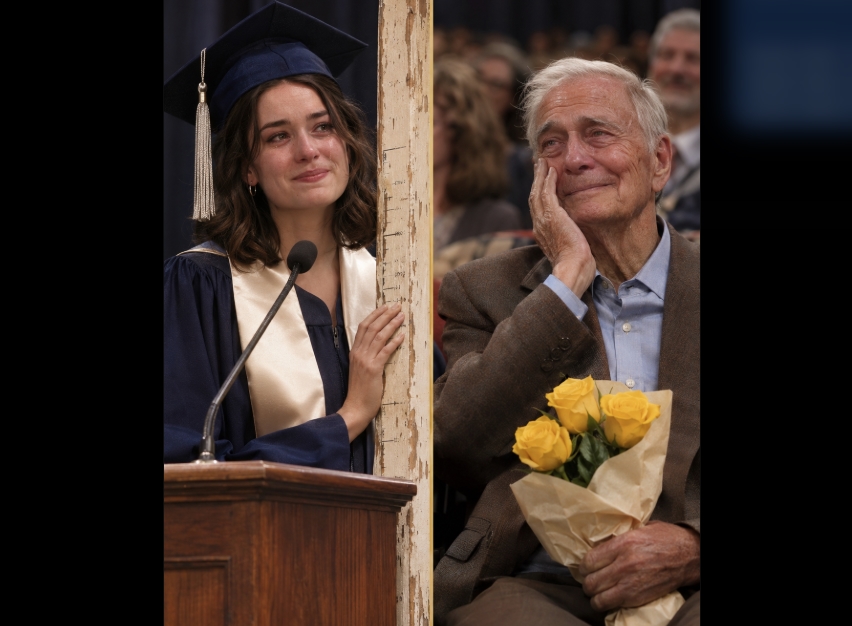
For a moment, I couldn’t hear anything.
The auditorium, the applause that had greeted Emma, the rustling programs—all of it seemed far away.
I knew that wood.
There was a small crescent-shaped dent near the bottom, where I had once dropped a clamp. Halfway up, a patch of white paint marked the afternoon Emma had decided my workshop needed “decorating.”
But the words she was pointing to were on the back.
The side that had stood against the wall.
Emma looked toward the aisle.
“Grandpa, would you come here?”
I shook my head instinctively.
There were hundreds of people watching. My knees weren’t steady. I had spent most of my life making things other people stood beside for photographs.
Then she smiled.
“You can bring the flowers.”
A few people laughed gently.
I began walking.
As I passed the front row, Victor reached toward my sleeve.
“Frank, this is her moment.”
For eighteen years, I had swallowed things I wanted to say to that man.
That morning, I simply moved my arm out of his reach.
“She asked me to come.”
An usher helped me up the steps.
Emma set the wood against the lectern and took my free hand.
“I saved you a seat,” she whispered.
“I know.”
“Why were you at the back?”
“Later, sweetheart.”
Her eyes searched mine. Then she nodded.
She returned to the microphone.
“When I was little, my grandfather kept a stool in his workshop so I could sit beside him while he worked. He taught me to measure twice. He listened while I practiced reading. He kept juice boxes in the same cupboard as his sandpaper.”
She glanced at me.
“He said that was an excellent filing system.”
“It was,” I murmured.
She laughed, then wiped her cheek.
“Every year, he measured how much taller I’d grown.”
Her finger moved over the pencil lines.
“After Mom died, he kept doing it. Even the year I said I was too old.”
“You were standing on your toes.”
More laughter.
Emma waited until it settled.
“When I went to college, Grandpa sold his workshop. He told me he wanted to retire. I believed him because I wanted to believe everything was easy for him.”
I looked at my shoes.
“Last month, I went to see the man who bought the building. I wanted a photograph of the place for a graduation gift.”
She paused.
“He told me Grandpa had asked for the sale to happen quickly. Before my first tuition payment was due.”
I squeezed her hand.
She looked at me, lowering her voice.
“Is it okay if I tell them?”
I could have said no.
I almost did.
But I had spent four years making sure she never felt responsible for what I had chosen.
Perhaps she deserved to explain what that choice meant to her.
I nodded.
“My grandfather had worked in that building for thirty-two years,” she said. “He built the benches himself. My mother’s handprints were in the concrete by the back step.”
My throat tightened.
“He gave it up so I could come here.”
Across the auditorium, people sat very still.
“I’m grateful to my teachers, to the people who gave me a scholarship, and to everyone who helped me through these four years.”
She turned toward me.
“But Grandpa, when I called because I thought I couldn’t do it, you were the person who stayed on the phone.”
She reached for the piece of wood.
“And I think Mom knew you would.”
I remembered the day we fitted that doorframe.
Emma had just turned four.
My daughter, Anna, had brought her to the shop with a paper bag of sandwiches. I was replacing a damaged strip beside the office door.
Anna had teased me about making such a fuss over a piece of wood.
“It’s straight,” she said.
“It’s nearly straight.”
She had rolled her eyes.
I went outside to help a delivery driver unload timber. When I came back, Anna was sitting on the floor, helping Emma put the cap on a blue marker.
I assumed they had been drawing.
A little over a year later, Anna was gone.
I fitted that wood, measured Emma against it, cleaned it, and leaned on it on days when I missed my daughter so badly I could barely work.
All those years, I never knew what was on the back.
Emma turned it toward me.
The blue ink had faded, but Anna’s handwriting was unmistakable.
Dad—if she grows up knowing even half the love I did, she’ll be all right.
Underneath it was a small, uneven handprint.
Emma’s.
I touched the words.
For eighteen years, I had wondered whether I had done enough.
Every missed school notice. Every burnt dinner. Every time Emma cried for her mother and I had no answer that could help.
Now my daughter’s handwriting was beneath my fingertips.
I bent my head.
Emma put her arms around me, and for a while I forgot we were on a stage.
Later, people told me there had been a standing ovation.
I don’t remember it.
I remember Emma asking whether I was all right. I remember someone bringing a chair.
And I remember watching from beside the stage as my granddaughter received her nursing degree.
When she held it up, she mouthed two words.
“We did.”
Outside, families gathered beneath the trees.
Emma was arranging her cap when Victor approached, carrying his enormous bouquet.
“That was quite a speech,” he said.
She looked at him.
“Where did you tell Grandpa to sit?”
Victor shifted the flowers.
“I didn’t tell him to sit anywhere.”
“You told me the chair was taken,” I said.
He gave a small, uncomfortable laugh.
“There seems to have been a misunderstanding.”
Emma glanced at the three yellow roses in my hand.
“Grandpa, what happened?”
I wanted to dismiss it.
There was a photographer waiting. She should have been laughing with her friends.
But she was watching my face in the same patient way Anna used to.
“He thought I might embarrass you,” I said.
Victor looked away.
Emma took a slow breath.
Then she faced him.
“I invited you because you asked for a chance to know me.”
“I am your father.”
“Yes,” she said. “And you’ve missed a lot. I was willing to talk about that. But you don’t get to push Grandpa aside to make yourself look closer to me.”
“I wasn’t trying—”
“He has never embarrassed me.”
She didn’t raise her voice.
She didn’t need to.
“Today, I’m having lunch with him. We can talk another day, if you’re willing to be honest.”
Victor stood holding flowers nobody reached for.
For a moment, I thought he would argue.
Instead, he looked at me.
“I shouldn’t have said that.”
“No,” I answered. “You shouldn’t.”
There was no sudden embrace. No promise that eighteen years could be repaired before lunch.
He left quietly with his wife.
Emma watched him go.
“Are you sorry you invited him?” I asked.
She thought about it.
“I’m sorry about what happened. I’m not sorry I gave him a chance.”
I nodded.
That sounded like my daughter, too.
At lunch, Emma placed the piece of doorframe on the booth beside her.
I kept looking at it.
“How did it survive?”
“The new owner is converting the building into offices. He took that piece down during the work.”
My stomach tightened.
“He nearly threw it away,” she admitted. “Then he saw the height marks. He put it on a shelf in case you wanted it.”
“Mr. Collins?”
She nodded.
“He remembered the little girl who used to do her homework in your office.”
I smiled.
“He used to bring you peppermint sweets.”
“He still keeps them in his desk.”
We sat quietly for a moment.
Then Emma reached across the table.
“Why didn’t you tell me about the money?”
“Because you would have tried to stop me.”
“I could have waited. Worked more.”
“You were already working.”
“But the shop was yours.”
“Yes.”
I needed her to understand that part.
I had loved the place. Selling it had hurt. Some mornings, for months afterward, I had put my work boots on before remembering I had nowhere to go.
“I miss it,” I admitted.
Her eyes filled.
“I’m sorry.”
“Don’t be sorry you went to college. I chose to help you. You didn’t take anything from me.”
She nodded, but I could see she was still thinking.
Then she said, “I can’t buy you another workshop.”
I laughed.
“I wasn’t going to put it on your graduation list.”
“But you’ve got the garage. And the bench you kept.”
“I do.”
“Would you teach me to make something?”
I looked at her.
“You have a new job starting.”
“Next month. I’m free on Saturday.”
For four years, whenever she came home, I had tried to make her rest.
It had never occurred to me that she might want to spend a day making sawdust with her grandfather.
“What did you have in mind?”
“A stool,” she said. “Like the one I sat on.”
We mounted the piece of doorframe beside my kitchen door.
I used small brackets that let us lift it away from the wall whenever we wanted to read Anna’s words.
Emma insisted on checking it with a spirit level.
“It’s straight,” I told her.
“Nearly straight.”
I had to put down the screwdriver for a moment.
On Saturday, she arrived wearing old jeans, carrying sandwiches in a paper bag.
We spent an hour choosing wood.
Another hour measuring.
The first stool wobbled.
Emma stared at it in dismay.
“I’m going to be trusted with patients, and I can’t make four legs the same length.”
“Different skill,” I told her.
So we started again.
By late afternoon, the stool stood firmly on the garage floor.
Emma sat on it and grinned.
I took a photograph.
Then she stood beside the piece of doorframe in the kitchen and handed me a pencil.
“One more?”
“You haven’t grown since the last mark.”
She looked toward the garage, where our tools still lay across the bench.
“I think we both have.”
I made a small line beside the old ones and wrote the date.
Then, for the first time, Emma took the pencil from my hand.
“Your turn, Grandpa.”
THE END
Original fictional story.