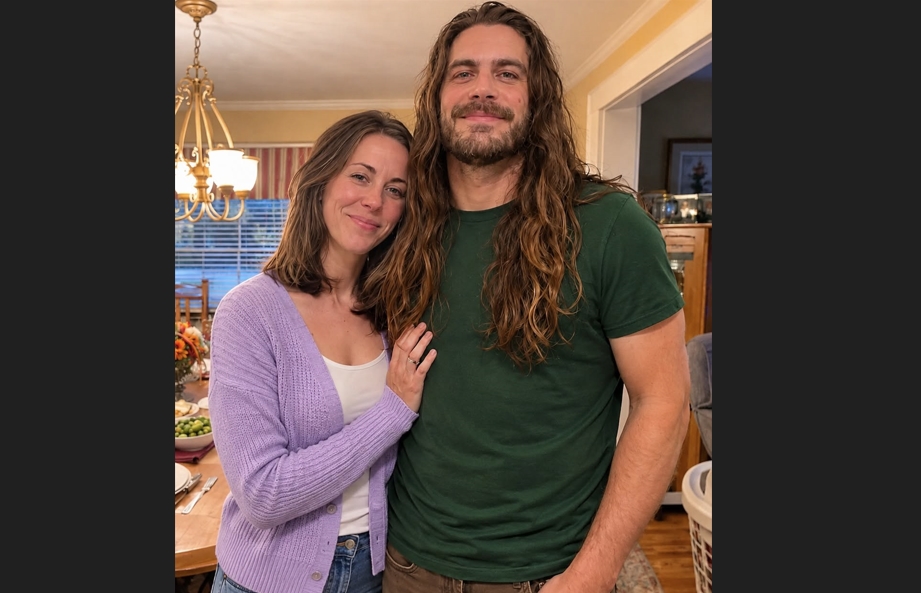
“She knows I have scars,” Adam said. “She doesn’t know how I got them.”
I stood and moved beside him.
Beneath his hair, an uneven patch of pale skin stretched across the back of his head. A narrow scar disappeared behind his ear.
I had felt that raised line before.
“An old accident,” he’d told me once, gently moving my hand. I had taken the hint.
Now I looked at my father.
“What did you think I needed to know?”
Dad opened his mouth, but Adam answered first.
“Let me tell you.”
He released his hair. It fell over the scars, and suddenly he looked like the husband who had been laughing beside me five minutes earlier.
Except his hands were trembling.
I took one of them.
“I was thirteen,” he said. “My father decided my hair was embarrassing him. He said I needed to look like a real man.”
Dad flinched.
Mom slowly lowered herself into her chair.
“He’d cut it himself before. Usually when he was angry about something else. My grades. My room. The way I answered a question.”
Adam watched the scissors on the floor.
“The last time, I said no.”
The refrigerator hummed in the kitchen. Somewhere outside, a car door closed.
“He grabbed me. I pulled away. He shoved me, and I hit the corner of a radiator.”
“Oh, Adam,” Mom whispered.
“He told the people at the hospital I’d fallen. When a nurse asked me what happened, he answered for me.”
“What did you do?” I asked.
“I waited until he went to make a phone call. Then I asked her to call my aunt Ruth.”
I knew Ruth. She sent us birthday cards with twenty-dollar bills tucked inside, even though we always told her to keep the money. She had raised Adam through high school.
He’d said living with her had been easier.
I had never understood how much that sentence left out.
“She came that night,” he continued. “And when the nurse asked me again, Ruth sat beside me while I told the truth.”
Dad’s eyes had filled.
Adam wasn’t looking at him anymore.
“There were questions afterward. Meetings. People deciding where I could live. I kept worrying they’d send me back.”
“Did you ever go back?” I asked.
He shook his head.
“Ruth collected my things.”
He paused, pressing his thumb against my wedding ring.
“The first week at her house, she took me shopping. I thought she’d make me get a haircut before school. Instead, she let me choose a comb.”
A small, uncertain smile crossed his face.
“When we got home, she put it on my dresser and said, ‘Your hair belongs to you. Nobody here is going to hold you down.’”
Mom wiped her cheeks.
“I let it grow. At first, it covered everything. People stopped asking questions. Later, I liked it.”
He finally looked at Dad.
“And every time you told me to cut it, I was thirteen again, trying to work out whether saying no would make things worse.”
Dad bent to pick up the scissors. He held them awkwardly, then set them on the kitchen counter.
“I didn’t know.”
“No,” Adam said. “You didn’t.”
“I would never have actually—”
“You handed me scissors in front of everyone.”
Dad fell silent.
“You wanted me to obey you,” Adam continued. “And if I wouldn’t, you wanted me to feel ashamed.”
For once, my father had no argument ready.
I picked up my bag.
“We’re leaving.”
Mom stood. “Of course. Let me get your coats.”
Dad took a step toward us, then stopped.
“Adam, I’m sorry.”
My husband nodded once.
“I heard you. I need to go home now.”
***
In our driveway, Adam switched off the engine but didn’t reach for his seat belt.
“I didn’t plan to tell it like that,” he said.
“You didn’t have to tell it at all.”
“He kept looking at me like there was something wrong with me.”
His voice broke on the last word.
I had seen Adam carry an injured dog out of traffic. I’d watched him stay late at the garage because a stranger couldn’t afford to miss work the next morning.
But I had never seen him cry.
I moved closer and waited until he leaned against me.
“I’m sorry too,” I whispered.
He pulled back. “You didn’t hand me the scissors.”
“I kept turning his comments into jokes. I thought that made them smaller.”
“You were trying to help.”
“I know. But next time, we leave at the first insult.”
He wiped his face with his sleeve.
After a while, he said, “You can ask me things.”
“Tonight?”
“Maybe not tonight.”
“Then not tonight.”
We went inside. I made sandwiches because neither of us had eaten dinner.
We sat on the couch, still wearing our good clothes, and shared a plate.
***
Three days later, Dad sent a message.
There was no explanation about how he’d been raised. No complaint that Adam had misunderstood a joke.
*I humiliated you in my home. I’ve been doing it for years, and I called it concern for my daughter. You have been a good husband to her. I have treated you badly.*
*You don’t owe me a visit or a reply. If you ever want to speak, I will listen.*
Adam read it twice.
Then he set the phone down.
“Better than ‘sorry you were offended,’” he said.
“Much better.”
He didn’t answer that day.
Or the next.
Dad didn’t send another message demanding to know why.
Two weeks later, Adam agreed to meet him for coffee.
When he came home, I tried to read his face.
“How was it?”
“He apologized.”
“And?”
Adam hung his jacket on its hook.
“And then he let me finish talking.”
It was a beginning.
***
A month later, we visited Ruth.
She opened her door, took one look at Adam, and said, “Something’s been bothering you.”
He laughed softly. “You always say that.”
“And I’m usually right.”
Over tea, he told her about dinner.
She listened without interrupting. When he finished, she reached across the table and covered his hand.
“I’m sorry you had to explain yourself that way.”
“I’m okay.”
“I know you can manage,” she said. “That doesn’t mean it didn’t hurt.”
Later, while Adam carried a box down from her attic, I helped her wash the cups.
“He fixes cars for people who can’t pay,” I told her. “Sometimes he won’t even tell me how much he’s spent on parts.”
Ruth smiled.
“He started with mine.”
“Really?”
“That dreadful blue station wagon. If it didn’t start, I couldn’t get to work. He’d stand beside the neighbor who helped me repair it and ask a hundred questions.”
She dried a cup carefully.
“The first time he got it running by himself, he came into the kitchen with grease all over his face. Told me I didn’t have to worry about losing my job anymore.”
I looked toward the hallway.
“He was still a child.”
“Yes,” Ruth said. “I had to remind him of that.”
When Adam came back downstairs, I wrapped my arms around him.
He glanced at Ruth over my shoulder.
“What did you tell her?”
“About the station wagon.”
“That thing was a disaster.”
“And yet,” she said, “you kept it going.”
***
We didn’t return to my parents’ house the following Sunday.
Rebuilding something took more than one good apology.
Dad met Adam for coffee again. He asked about the garage and listened to the answer. When Adam disagreed with him, Dad learned to let the disagreement stand.
Mom called my husband herself.
“I should have done more than change the subject,” she told him. “I’m sorry I left you sitting through it.”
Eventually, Adam said he wanted to try dinner again.
“Are you sure?” I asked.
“Yes. And if I change my mind halfway through, we can go.”
“We can.”
That evening, my father opened the door and stepped aside.
“Good to see you, Adam.”
“Good to see you too, Frank.”
Dad’s eyes stayed on his face.
During dinner, Adam leaned forward to reach a serving dish. His hair slipped over his shoulder, and he searched his wrist for a hair tie.
Without thinking, I handed him the spare one I kept in my bag.
He gathered his hair and tied it back.
The scar behind his ear showed.
For a moment, I stopped moving.
Then Mom asked if we wanted more potatoes.
Dad passed the bowl to Adam.
Nobody stared. Nobody asked another question about his head.
My husband took a helping and continued telling us about a customer who insisted the strange noise in her car was a serious engine problem.
“It was a jar of coins under the passenger seat,” he said.
Dad started laughing.
So did Mom.
Adam caught my eye across the table. His shoulders had relaxed.
Later, while we were putting on our coats, Dad approached him.
“May I give you a hug?”
Adam considered it.
Then he stepped forward.
It was brief and a little awkward. Neither of them pretended otherwise.
On the drive home, Adam lowered his window an inch. A few strands had escaped his hair tie, and the breeze moved them against his cheek.
“How do you feel?” I asked.
He thought about it.
“Like I might actually want to go back.”
I reached for his hand.
His hair was just as long as it had been at that first dinner.
This time, he had come home without having to defend it.
**THE END**