On a quiet stretch of countryside, where the road winds gently between fields and trees, a moment unfolded that quietly reminded us what compassion looks like in real life. It wasn’t planned, and it wasn’t staged. It was simply a situation where someone chose to stop, assess, and act with care.
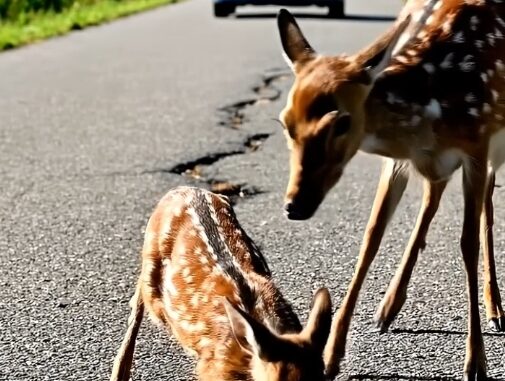
A driver moving along this peaceful road noticed something unusual ahead. A mother deer stood near the edge of the pavement, visibly distressed. She wasn’t grazing or crossing—she was lingering, pacing, and watching something on the ground with intense focus. As the vehicle slowed, the reason became clear. Her young fawn had become trapped, its small leg caught in a narrow crack in the pavement.
Situations like this can be difficult. Wildlife encounters are unpredictable, and approaching an animal—especially a protective parent—requires caution. Many people, understandably, might hesitate or continue on their way, unsure of what to do or worried about making things worse. But in this moment, the man behind the wheel made a different choice.
He stopped.
Carefully stepping out of his vehicle, he kept his movements slow and deliberate. The mother deer remained nearby, alert and protective, her instincts telling her to stay close but also to be wary. The man seemed to recognize this balance. He didn’t rush forward or make sudden gestures. Instead, he approached with patience, giving the animal space while quietly assessing the situation.
The fawn was struggling but exhausted. Its leg was lodged deep enough that it couldn’t free itself. Time mattered. With steady hands and a calm demeanor, the man gently reached down, positioning himself in a way that would minimize stress for both animals. In one careful motion, he lifted and guided the fawn’s leg free from the crack.
For a brief moment, everything stood still.
The fawn, now released, quickly regained its footing. It stayed close to its mother, who did not flee immediately. Instead, she lingered—just for a few seconds—watching the man. While we can’t assign human emotions to animals with certainty, there was something undeniably powerful in that pause. It felt like acknowledgment. A silent understanding that no harm had been intended—only help.
Then, just as quietly as it began, the moment ended. The deer turned and moved back toward the safety of the fields, the fawn close at her side.
What makes this story resonate isn’t just the act itself, but the decision behind it. In a fast-moving world, it’s easy to stay focused on our own destinations, our own timelines. Stopping to help—especially in an uncertain situation—requires awareness, empathy, and a willingness to take responsibility in the moment.
It also highlights the importance of approaching such situations thoughtfully. The man didn’t act recklessly. He remained calm, respected the animal’s space, and intervened only when it was clear that help was needed. That balance between action and caution is what made the outcome positive.
Encounters like this serve as reminders that small acts can have meaningful impacts. Kindness doesn’t always require grand gestures. Sometimes, it’s about noticing when something isn’t right and choosing not to ignore it.
It also invites reflection. If you had come across the same scene, what would you have done? Would you have stopped? Would you have felt confident stepping in, or unsure of how to respond?
There’s no single correct answer, and every situation is different. Safety—both for people and animals—should always come first. But what remains consistent is the value of awareness and compassion. Even when we’re unsure, simply taking a moment to observe, think, and consider helping can make a difference.
In the end, this quiet roadside moment wasn’t about recognition or attention. It was about doing what felt right in a situation where someone—or something—needed help. And sometimes, that’s enough to remind us that kindness, even in its simplest form, still matters.