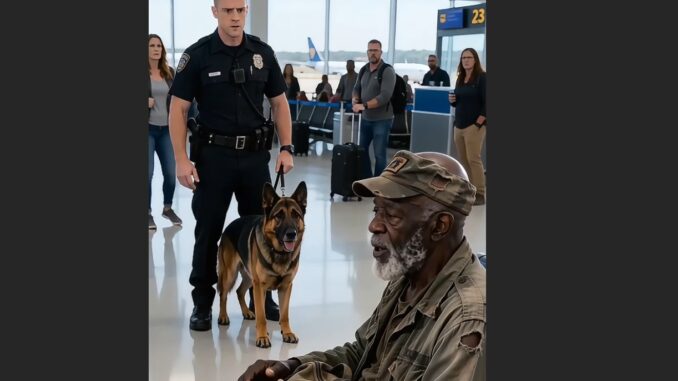
The airport gate was crowded that afternoon. Travelers stood in lines, families watched the departure screens, and the sound of rolling suitcases filled the terminal. Near one quiet corner of the gate, an old veteran sat alone with a worn duffel bag by his feet.
His clothes were simple and faded. His jacket looked old, and his veteran cap had clearly seen many years. He did not speak loudly. He did not ask anyone for attention. He simply waited for his flight like everyone else.
But not everyone saw him that way.
A police officer standing nearby began watching him closely. Beside the officer was a trained German Shepherd K9. The dog was alert, calm, and focused, standing beside its handler as people moved around the gate.
After a moment, the officer walked toward the old man with a serious expression.
“Sir, stay seated,” the officer said firmly. “My K9 is going to check your bag right now.”
The people nearby became quiet. Some travelers turned their heads. Others slowed down, curious about what was happening. The veteran looked up at the officer, then down at the dog.
He did not argue. He did not raise his voice. He only lifted his hands slightly to show he had nothing to hide.
“Go ahead, officer,” the old man said calmly. “He probably remembers me better than people do.”
The officer did not understand what that meant. He gave the command, and the K9 moved toward the veteran.
For a few seconds, the entire gate seemed to hold its breath. Everyone expected the dog to search the bag, bark, or give some kind of signal.
But the moment the K9 reached the old veteran, something completely unexpected happened.
The dog stopped.
It stared at the man’s face, then lowered its head and made a soft sound. A second later, its tail began to move. Instead of acting tense, the K9 stepped closer and gently pressed its body against the veteran.
The old man’s eyes softened. He reached down slowly and placed his hand on the dog’s head.
“Easy there, Ranger,” he whispered. “Still remember your training, huh?”
The officer froze.
The travelers around them stared in silence. The dog sat down beside the veteran as if it had found someone it trusted completely. It refused to move away, even when the officer called it back.
The officer’s face changed from suspicion to confusion.
“Wait,” he said. “How does my K9 know you?”
The veteran reached into his jacket pocket. The officer immediately became alert, but the old man moved slowly and carefully. He pulled out an old badge and held it where the officer could see.
It was not an ordinary badge.
It was a military K9 training badge.
The veteran looked at the officer and said, “Because before you worked with him… I trained him for service.”
The officer’s expression dropped. He looked at the badge, then at the dog sitting proudly beside the veteran. The truth became clear at once.
This was not just an old man waiting at a gate. He was the person who had helped train the K9 before the dog ever wore a police harness. The animal remembered his voice, his hands, and the bond they had built during training.
The officer stepped back, embarrassed by how quickly he had judged the man.
“Sir,” the officer said quietly, “I apologize.”
The veteran nodded, but he did not look angry.
“Just remember,” he said, “sometimes the people who look the most forgotten have served the longest.”
The officer lowered his eyes and thanked him for his service. A few travelers nearby began to clap softly. Others simply stood in silence, moved by what they had witnessed.
Ranger stayed beside the veteran until boarding began. The officer personally helped carry the old duffel bag to the gate entrance and made sure the veteran boarded comfortably.
Before leaving, the dog looked back one last time. The veteran smiled and gave a small salute.
And that was the moment everyone at the gate understood the lesson: respect should never depend on someone’s clothes, age, or appearance. Sometimes, the strongest stories are carried quietly by the people we almost overlook.
End of story.