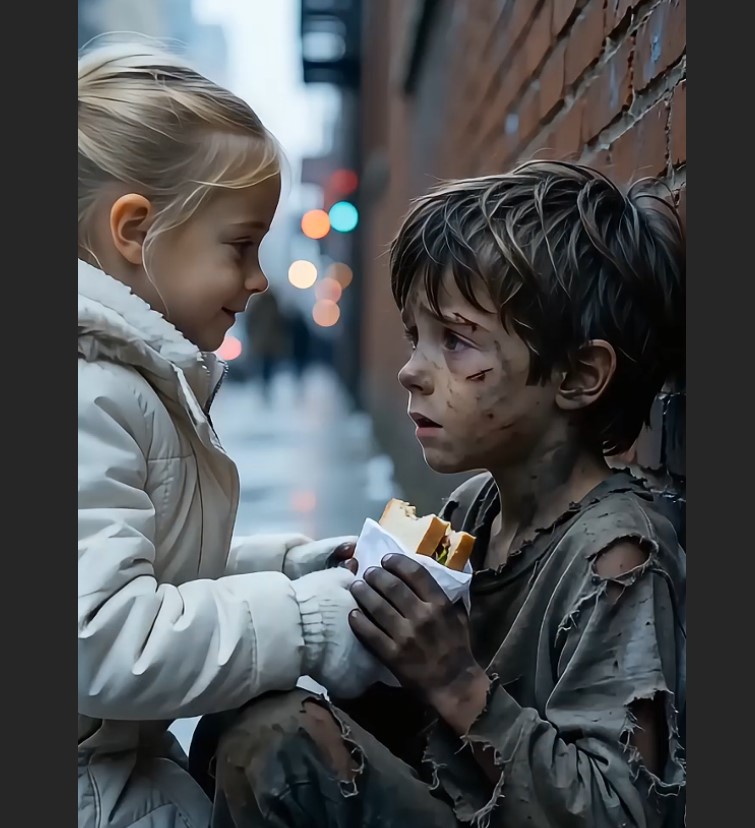
The woman’s hands shook as she held the boy’s face between her palms.
For a moment, nobody moved.
The little girl stood beside her mother, confused and frightened, still trying to understand why a simple act of kindness had turned into tears.
The boy stared at the woman through watery blue eyes.
“Mom?” he whispered again, as if he was afraid the word might disappear if he said it too loudly.
The woman pulled him into her arms and held him so tightly that the sandwich fell from his hands.
“Eli,” she cried. “My Eli. I thought I would never see you again.”
The boy’s body went stiff at first. He had learned not to trust sudden emotion. He had learned that adults could promise safety and still leave. But the sound of her voice was familiar. Her perfume was faint beneath the cold air, but he remembered it.
Then his small arms slowly wrapped around her neck.
“I waited,” he cried. “I waited for you.”
The woman broke down completely.
Two years earlier, Eli had disappeared during a crowded winter market. One moment he had been holding his mother’s hand. The next, he was gone. There had been police searches, posters, interviews, sleepless nights, and false calls from strangers who claimed they had seen him.
Eventually, the world had moved on.
But his mother never had.
Every birthday, she still bought a small cake. Every winter, she still kept his blue scarf in her drawer. Every night, before sleeping, she still whispered his name like a prayer.
And now he was here.
Cold. Hungry. Changed.
But alive.
“Where were you?” she asked, brushing dirt from his cheek.
Eli swallowed hard.
“A man took me,” he said quietly. “He said you didn’t want me anymore.”
The mother covered her mouth, unable to breathe for a second.
“No,” she said firmly. “No, my love. I searched for you every day.”
The little girl in the white coat stepped closer.
“Mom,” she asked softly, “is he my brother?”
The woman looked at her daughter through tears.
“Yes,” she said. “This is your brother.”
The girl’s eyes widened. Then she looked at the boy with a new kind of tenderness.
She picked up the sandwich, brushed the paper clean, and handed it back to him.
“Then you can have the whole thing,” she said. “Brothers get extra.”
For the first time, Eli smiled.
It was small. Weak. Almost broken.
But it was real.
The mother removed her coat and wrapped it around his shoulders. Then she took out her phone and called the police, not with panic this time, but with a trembling voice full of hope.
“I found him,” she said. “I found my son.”
Within minutes, officers arrived. An ambulance came too, checking Eli gently while his mother refused to let go of his hand.
At the hospital, doctors said he was weak, hungry, and exhausted, but he would recover.
That night, Eli slept in a clean bed for the first time in years.
His mother sat beside him until morning.
Every time he stirred, she whispered, “I’m here.”
And every time, he relaxed again.
The little girl who had offered him a sandwich became the reason a lost child came home. She had not seen torn clothes, dirty hands, or a stranger in an alley.
She had only seen a hungry boy.
And because she stopped when everyone else kept walking, a mother found the child she had never stopped loving.
Weeks later, Eli stood in front of a mirror wearing clean clothes and a warm sweater. The scar under his eyebrow was still there, but now it no longer looked like a mark of pain.
It looked like proof.
Proof that he had survived.
Proof that kindness can find what the world has lost.
And proof that sometimes, the smallest heart in the street can lead a family back together.
From that day on, Eli never had to sit alone against a cold brick wall again.