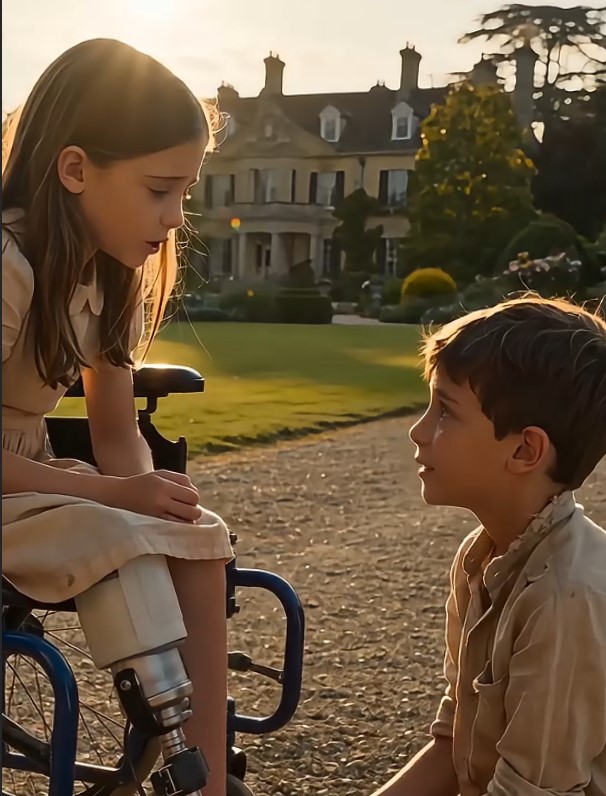
The water splashed across the gravel.
The metal basin rolled away.
Rose gasped as the boy fell backward onto the driveway.
“Daddy, stop!” she cried.
Her father stood over the boy, breathing heavily.
“Stay away from my daughter,” he said. “I don’t want strangers filling her head with false hope.”
The boy slowly pushed himself up from the ground.
His clothes were soaked, but he did not look angry.
Instead, he looked at Rose’s father with surprising calm.
“I wasn’t trying to hurt her.”
“Then what were you doing?” the father demanded.
The boy glanced toward Rose.
“Trying to help her remember how to hope.”
The words struck harder than the father’s own anger.
For a moment, nobody spoke.
Then Rose looked down.
“He’s the first person who asked how I felt.”
Her father turned toward her.
“What?”
Tears filled her eyes.
“Everyone asks about my legs. Doctors ask about my legs. Therapists ask about my legs. You ask about my legs.”
She swallowed hard.
“He’s the first person who asked why I was sad.”
The driveway became silent.
Rose’s father suddenly felt something he had not felt in years.
Guilt.
After his wife’s death, he had spent every waking moment trying to fix Rose’s condition.
But somewhere along the way, he had forgotten that his daughter needed more than treatment.
She needed comfort.
She needed friendship.
She needed hope.
The father slowly looked back at the boy.
“Why did you help her?”
The answer came immediately.
“Because she looked lonely.”
Rose’s father lowered his eyes.
Those four words shattered the wall he had built around himself.
For years he had blamed the world for what happened to his family.
But this child, who had almost nothing, still chose kindness.
The father finally stepped forward.
Not in anger.
In regret.
“I’m sorry.”
The boy blinked in surprise.
“For what?”
“For seeing your clothes before I saw your heart.”
Rose smiled for the first time that day.
Over the next months, the boy became a regular visitor to the estate.
He and Rose spent hours talking beneath the apple trees.
They laughed together, read books together, and encouraged one another through difficult days.
Little by little, Rose began to change.
Her determination returned.
She worked harder during therapy.
She stopped focusing on what she had lost and started focusing on what she could still achieve.
One bright spring morning, nearly a year later, Rose stood between two support rails.
Her father watched nervously.
The boy stood beside him.
“You can do it,” he said.
Rose took a careful step.
Then another.
Then another.
Tears streamed down her father’s face.
It was not magic.
It was not a miracle.
It was hope, patience, courage, and the power of kindness.
Years later, Rose often remembered the afternoon a poor boy sat beside her on a gravel driveway and asked a simple question.
“Why are you sad?”
That question changed her life.
And it changed her father’s life too.