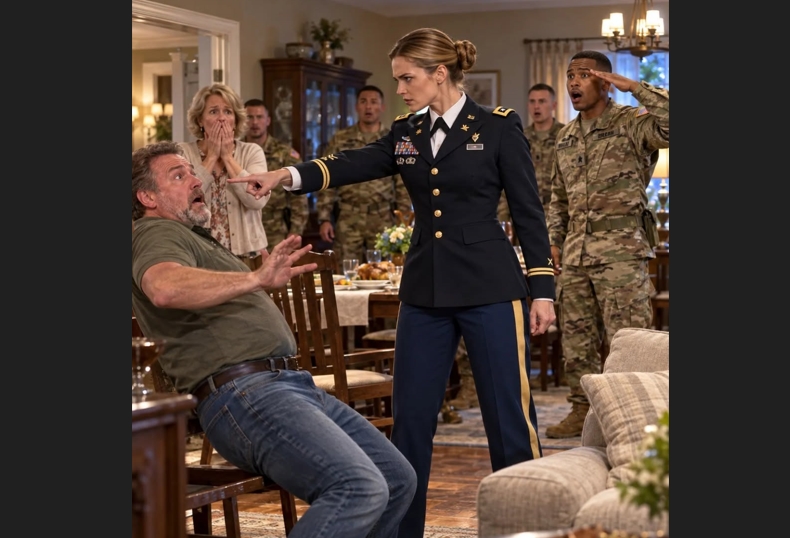
“Room, attention!”
The chair scraped backward so sharply that Martin nearly dropped his glass.
Staff Sergeant Daniel Ruiz stood beside the dining table, his eyes fixed on me. We had worked together two years earlier.
“At ease, Sergeant,” I said. “You’re a guest. Please sit.”
“Good to see you again, Major.”
Martin looked from Ruiz to the gold oak leaves on my shoulders.
“Major?”
“Yes.”
He gave a short, uncomfortable laugh.
“Well, you certainly kept that quiet.”
“You never asked what I did. You told me.”
Mom stood in the doorway holding a serving bowl. For once, she wasn’t rushing to fill the silence.
Martin pulled out his chair.
“Clearly, there’s been a misunderstanding. I was only trying to give her some guidance.”
I looked at the three soldiers around the table.
“Were you told you were coming here to teach me discipline?”
Ruiz’s expression changed.
“No, ma’am. Mr. Hale said your family wanted to thank us for helping at the community center.”
One of the others slowly put down his fork.
I nodded.
“Then I’m sorry you were brought into this.”
Martin’s face reddened.
“Oh, don’t make everything so dramatic. If I’d known you were an officer—”
“You would have treated me differently?”
“Of course I would.”
He stopped.
Nobody helped him finish.
I pulled out the empty chair beside Mom’s place.
“I should have been welcome at this table regardless.”
Martin glanced toward the hallway, where his embroidered cap hung beside the door.
I followed his eyes.
“Now tell them what rank you retired at.”
“That isn’t relevant.”
“You’ve mentioned it at almost every meal.”
“Claire,” he said, lowering his voice. “Be careful.”
Mom set the serving bowl down.
“No, Martin. Answer her.”
Earlier that afternoon, she had shown me a document he’d asked her to scan for a job application months before. She still had the copy.
Four years of Army service.
Specialist.
An honorable discharge.
There was nothing embarrassing about any of it.
Except that it wasn’t the career he had described to her.
Mom opened the sideboard drawer and placed the paper on the table herself.
“Claire explained this to me,” she said. “Were you ever a command sergeant major?”
Martin stared at the document.
“I did more than a piece of paper can show.”
“That wasn’t my question.”
For several seconds, the only sound was the kitchen clock.
Then he shrugged.
“I improved a few details. People take you seriously when they think you’ve accomplished something.”
Mom pulled out her chair and sat down.
I could see her hands trembling beneath the table.
“Did your pension ever get delayed?” she asked.
Martin looked up.
My stomach tightened.
“What pension?” I said.
“He told me that was why he couldn’t contribute to the bills yet.”
“Things were complicated,” Martin muttered.
Mom closed her eyes briefly.
When she opened them, she looked directly at him.
“You watched me take extra shifts.”
“I was going to help.”
“When?”
He had no answer.
She glanced at me, and I recognized the old instinct: apologize, smooth things over, get everyone through dinner.
Instead, she pushed her chair back.
“I want to end this, Martin.”
He stared.
“You’re doing this because she put on a uniform?”
“No. I’m doing it because I’ve been afraid to disagree with you in my own home.”
He turned toward me.
“Tell her she’s overreacting.”
I stayed quiet.
Mom had finally spoken. She deserved to hear her own words stand.
Martin waited another moment, then went upstairs. Twenty minutes later, he left with an overnight bag and a ride he had called himself.
He collected the rest of his belongings the following week. Mom had a friend with her. She declined his request to try again.
But that first evening, after the front door closed, she stood beside the untouched dinner.
“I’ve ruined everything,” she whispered.
Ruiz glanced at the table.
“Mrs. Bennett, those potatoes still look pretty good.”
She laughed unexpectedly, then covered her mouth.
I took the bowl from her hands.
We ate.
Later, while we washed the dishes, she said, “I should have stopped him the first time he spoke to you like that.”
“Yes,” I said gently.
She nodded, accepting it.
“I will next time.”
“The first time he speaks to you like that, too.”
She reached for my hand.
The next morning, I came downstairs at eight forty-seven.
Mom was making pancakes.
“I slept late,” she said.
“So did I.”
She poured two cups of coffee and pushed one toward my place at the table.
Then she turned back to the stove.
And while the first pancake browned, my mother began to sing.